


Chapel of the Cristo de Velarde in Oviedo Cathedral
En el primer tramo de la nave meridional de la Cathedral of San Salvador of Oviedo se encuentra la Chapel of the Cristo de Velarde, un espacio especialmente conocido por albergar uno de los Crucificados más destacados del templo.
The chapel takes its name from the Velarde family, who owned it from the mid-17th century. It had previously belonged to the canon Antonio Vázquez de Prada, who commissioned the celebrated image of the crucified Christ in the mid-16th century.
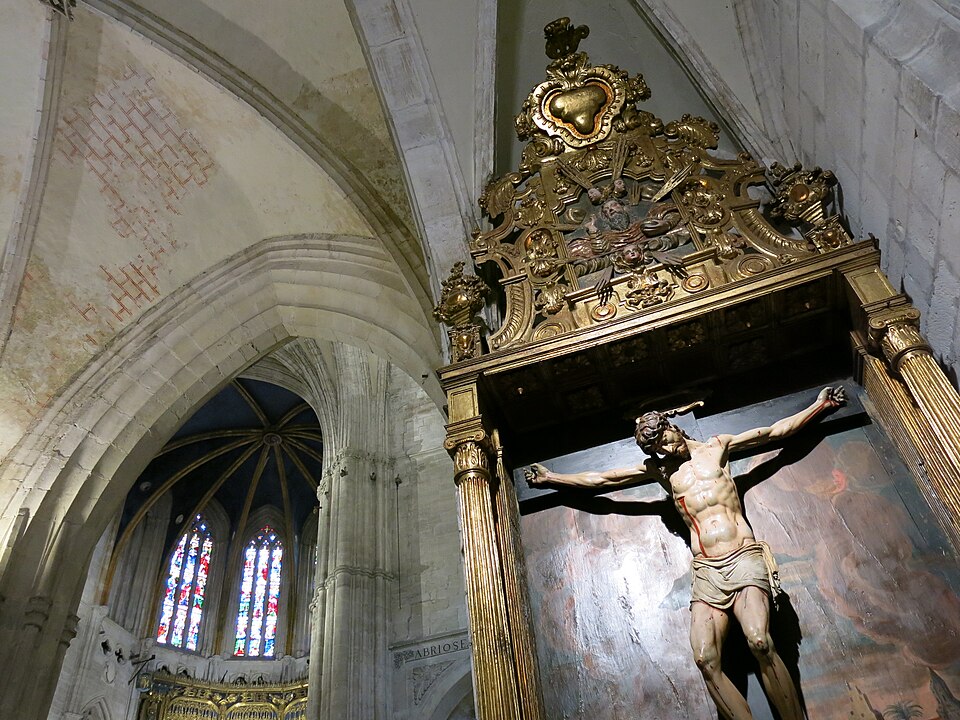
Chapel of the Cristo de Velarde in Oviedo Cathedral. Photograph: Enric / Wikimedia Commons, CC BY-SA 4.0 licence.
History of the chapel
Before becoming associated with the Velarde family, the chapel belonged to the canon Antonio Vázquez de Prada. In the mid-16th century, he commissioned the image of the crucified Christ that would eventually become the chapel’s most representative feature.
The chapel underwent a major transformation in the 18th century. In 1733, part of its space was given over to the construction of the monumental Baroque staircase leading to the Holy Chamber, built to provide a more dignified entrance to one of the Cathedral’s most historically and religiously significant spaces.
El Cristo de Velarde
The main focus of the chapel is the Cristo de Velarde, a polychrome wooden carving dating from the mid-16th century. The figure has elongated proportions and displays meticulous anatomical study, particularly visible in the torso, arms and legs.
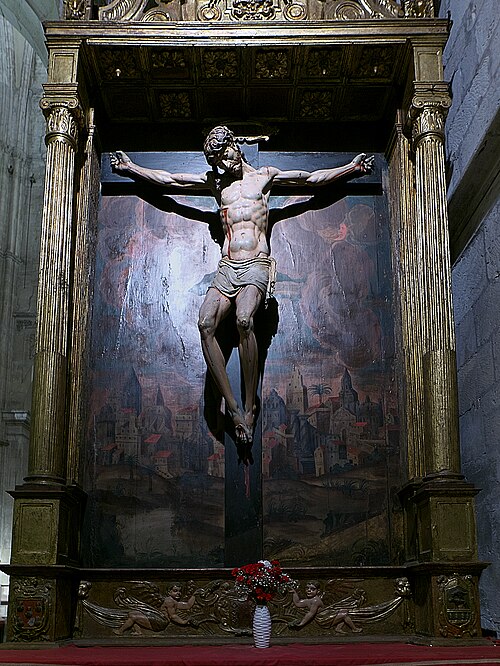
Cristo de Velarde, Oviedo Cathedral. Photograph: Jl FilpoC / Wikimedia Commons, CC BY-SA 4.0 licence.
The treatment of the body, the expressiveness of the figure and the quality of the execution reveal a clear Italian Renaissance influence. The result is an image of remarkable sculptural power, considered one of the finest works of sculpture preserved in Oviedo Cathedral.
A debated authorship
The authorship of the Cristo de Velarde has not been definitively established. Traditionally, the sculpture has been attributed to Alonso Berruguete, one of the great masters of Spanish Renaissance sculpture, although it has also been associated with Gaspar Becerra.
More recent studies and proposals have also pointed to affinities with the Italian artistic milieu and with the style of artists such as Pedro de Rubiales and Jacopino del Conte. It is therefore more accurate to describe the work as being of disputed authorship rather than definitively attributing it to Berruguete.
The Cristo and its altarpiece
The image is now incorporated into a later altarpiece that frames the Crucifix. The composition directs the viewer’s gaze towards Christ, the true visual and devotional focus of the chapel.
The contrast between the 16th-century Renaissance sculpture and the later decorative setting illustrates the Cathedral’s artistic evolution, as works from different periods were incorporated into spaces that also changed in appearance and function over the centuries.