


Chapel of Saint Barbara at Oviedo Cathedral
The Chapel of Saint Barbara, located on the south side of the Cathedral of San Salvador of Oviedo, is one of the most important examples of 17th-century Asturian Baroque art. It was conceived by Bishop Bernardo Caballero de Paredes as a new chapel for the Cathedral’s relics and as a family pantheon, although the original project was never fully completed.
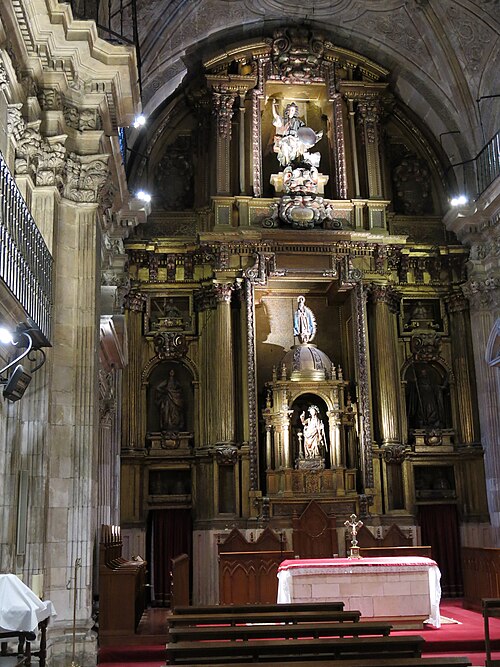
Interior of the Chapel of Saint Barbara. Photograph: Enric / Wikimedia Commons, CC BY-SA 4.0 licence.
The “New Holy Chamber”
In the mid-17th century, the veneration of relics acquired particular importance in the context of the Counter-Reformation. Bishop Bernardo Caballero de Paredes (1642–1661) proposed building a larger and more monumental chapel to which the relics kept since the Middle Ages in the Holy Chamber could be transferred.
The new building was also intended to serve as the pantheon of the bishop and his family. Contemporary documents refer to it as the “New Holy Chamber” and also as the Chapel of Saint Michael. The Cathedral Chapter, however, opposed the transfer of the relics, which remained in their historic location.
The work was commissioned from the architect Ignacio de Cajigal and was carried out mainly between 1660 and 1663. Caballero de Paredes died in 1661, before the chapel was completed.
A Baroque chapel within the Gothic Cathedral
The chapel has a rectangular plan and is divided into two clearly differentiated spaces: a nave for the faithful and a presbytery. The nave is covered by a dome on pendentives illuminated by a lantern, while the presbytery has a lunette vault.
Pilasters, balconies, niches and abundant vegetal decoration carved in stone articulate the interior. The funerary niches intended for the founder’s family form part of an architectural design conceived with a monumentality unusual among the Cathedral’s chapels.
A sacristy was later added behind the altar, built by Gregorio de la Roza between 1688 and 1689.
The reliquary-altarpiece
The large altarpiece occupying the end wall was conceived as an essential part of the chapel and is fully integrated into its architecture. Completed in 1663, it represents a milestone in the introduction of the Baroque altarpiece in Asturias.
The original programme was directly connected with the relics. The images of several saints incorporated small reliquary compartments intended to hold relics, thus reinforcing the function for which the new chapel had been designed.
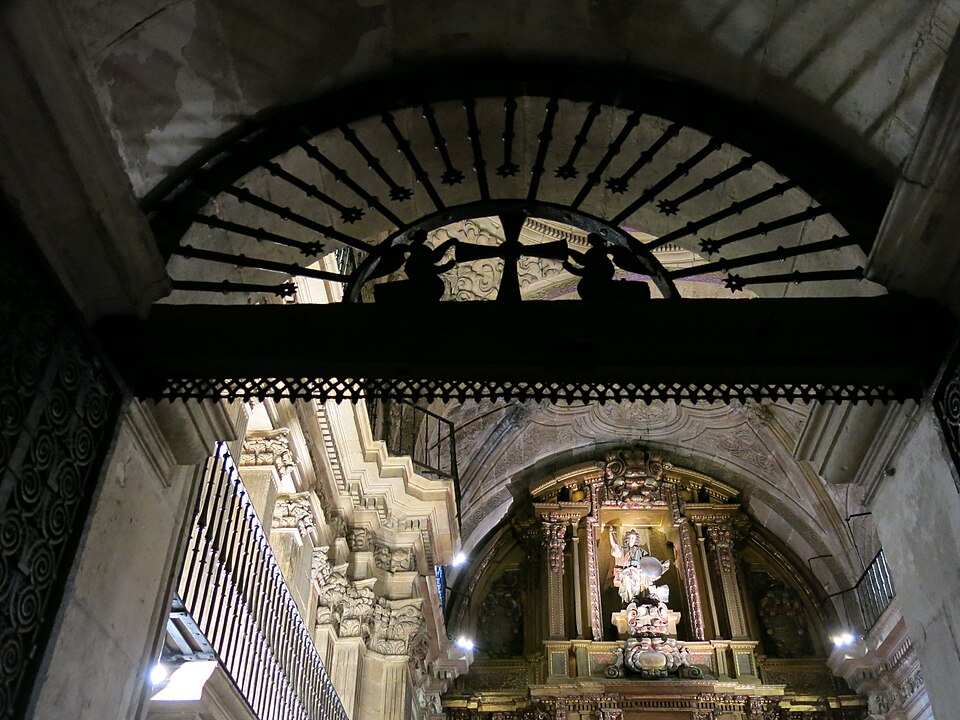
Saint Michael on the altarpiece of the Chapel of Saint Barbara, recalling its original dedication. Fotografía: Enric / Wikimedia Commons, CC BY-SA 4.0 licence.
In the upper section, the figure of Saint Michael the Archangel, the chapel’s original patron, stands out. The central axis also features an Immaculate Conception associated with the sculptural work of Luis Fernández de la Vega. The image of Saint Barbara, who would eventually give the chapel its definitive name, was made by Antonio Borja in 1713.
From Saint Michael to Saint Barbara
Once the transfer of the relics from the Holy Chamber was definitively abandoned, the chapel lost the main function for which it had been conceived. Over time it was dedicated to Saint Barbara, whose image came to occupy a central place on the altarpiece.
Today it remains a place of worship within the Cathedral. Its altarpiece underwent a major restoration completed in 2024, which recovered and enhanced its decoration.