17th century
La estructura arquitectónica de la girola fue levantada entre 1621 and 1633 según las trazas de Juan de Naveda.


The ambulatory, or deambulatory, of the Cathedral of San Salvador surrounds the main chapel and is one of the spaces that best illustrates the Baroque transformation of the church. It was built in the 17th century to facilitate the movement of pilgrims who came to venerate the relics of the Holy Chamber, without interfering with services in the main chapel.
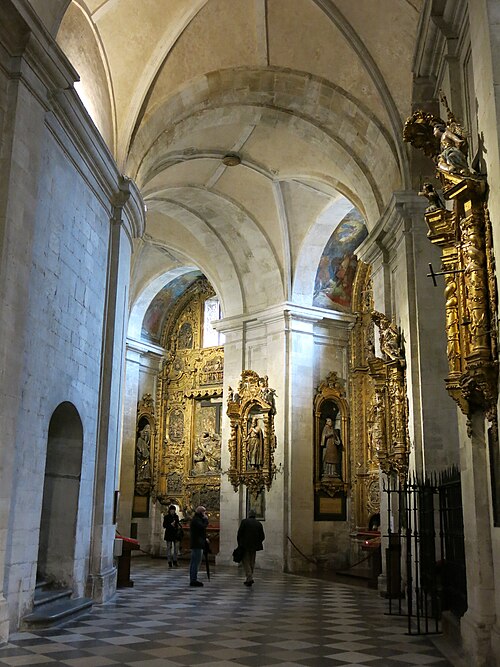
Ambulatory or deambulatory of Oviedo Cathedral, viewed from the south transept. Photo: Enric / Wikimedia Commons.
At the beginning of the 17th century, the Cathedral Chapter considered it necessary to adapt the church to the large number of pilgrims arriving in Oviedo. The layout of the Gothic cathedral made it difficult for worshippers visiting the relics of the Holy Chamber to move around, so it was decided to build an ambulatory around the east end.
To carry out the work, it was necessary to acquire part of the land belonging to the neighbouring monastery of San Vicente. Construction took place between 1621 and 1633 under the direction of the architect Juan de Naveda, one of the leading figures responsible for the work carried out on the Cathedral during that period.
The new ambulatory met both a practical and a religious need. In the context of the Counter-Reformation, devotion to saints and relics took on particular importance, and the new space made it possible to create a devotional route around the main chapel.
Although the ambulatory was added to an essentially Gothic cathedral, Juan de Naveda designed a classically inspired space intended to blend with the earlier architecture. The massive piers are articulated with Tuscan-order pilasters, while the design of the vaults recalls the ribbed vaulting of the medieval church.
The ambulatory is arranged around five chapels, of which the central one is wider and deeper. Between them rise the piers which, in addition to their architectural function, support numerous niches containing sculptures.
La estructura arquitectónica de la girola fue levantada entre 1621 and 1633 según las trazas de Juan de Naveda.
The sculptural decoration and altarpieces were added later, turning the space into one of the Cathedral’s most interesting Baroque ensembles.
The five chapels de la girola recuperan simbólicamente la antigua dedicación del templo del Salvador a los apóstoles. La mayor parte de su decoración actual corresponde al siglo XVIII y está estrechamente vinculada al escultor ovetense José Bernardo de la Meana and his workshop.
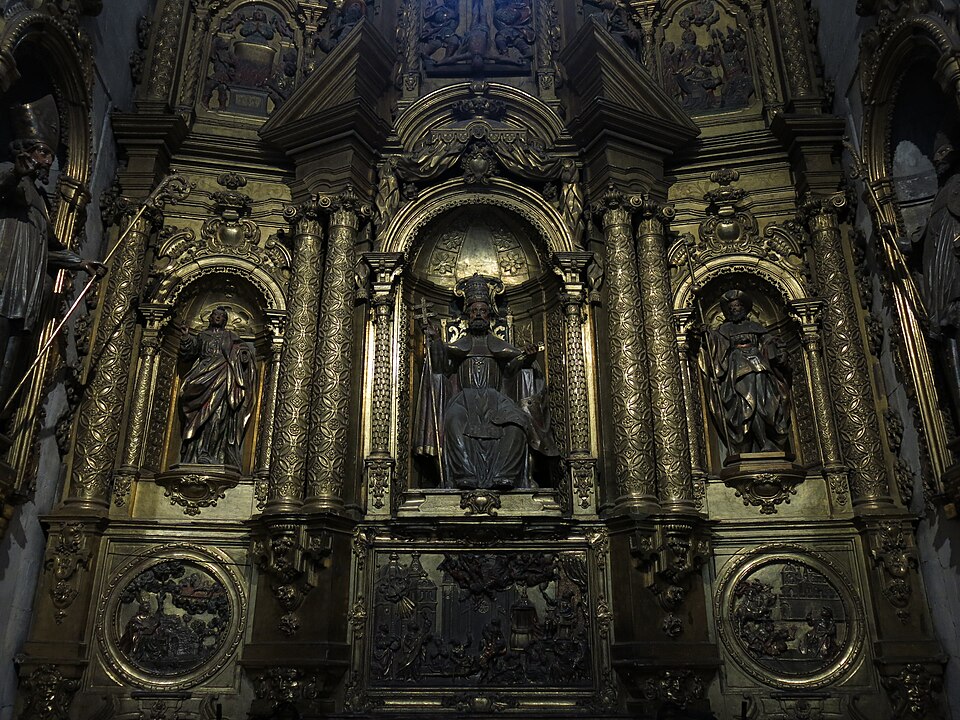
Altarpiece of Saint Peter, in the central chapel of the ambulatory of Oviedo Cathedral. Photo: Enric / Wikimedia Commons.
The piers separating the chapels contain a group of eighteen niches. They depict saints and martyrs whose relics are preserved in the Cathedral, as well as Fathers of the Church, prophets, founders of religious orders and saints who have traditionally enjoyed particular popular devotion.
Among the most notable figures is Saint Eulalia of Mérida, a work by Alejandro Carnicero made in 1743, together with several sculptures by José Bernardo de la Meana, including Saint Leocadia, Saint Jerome, Saint Emeterius, Saint Lucretia, Jeremiah and Isaiah.

Saint Eulalia of Mérida, en una hornacina de la girola de la Oviedo Cathedral. Photo: Enric / Wikimedia Commons.
His presence is linked to devotion to the saint as a protector against illness and to the existence of a relic in the nearby monastery of San Pelayo.
Traditionally much venerated as the protector of animals, he forms part of the ambulatory’s extensive devotional programme.
The patron saint of the diocese and the city is represented by a sculpture by Alejandro Carnicero, one of the ensemble’s distinctive works.
These penitential figures mark the beginning and end of the route through the ambulatory and reinforce the religious meaning of the space.
Near the entrance to the ambulatory from the south aisle stands one of the Cathedral’s most significant images: the sculpture of El Salvador, to whom the Cathedral is dedicated. It is an over-life-size polychrome stone sculpture dating from the 14th century and has stood in this location since the 17th century.
Christ is shown frontally, blessing with one hand and holding the orb in the other. For centuries, the image has been closely associated with pilgrims passing through Oviedo on their way to Santiago de Compostela.
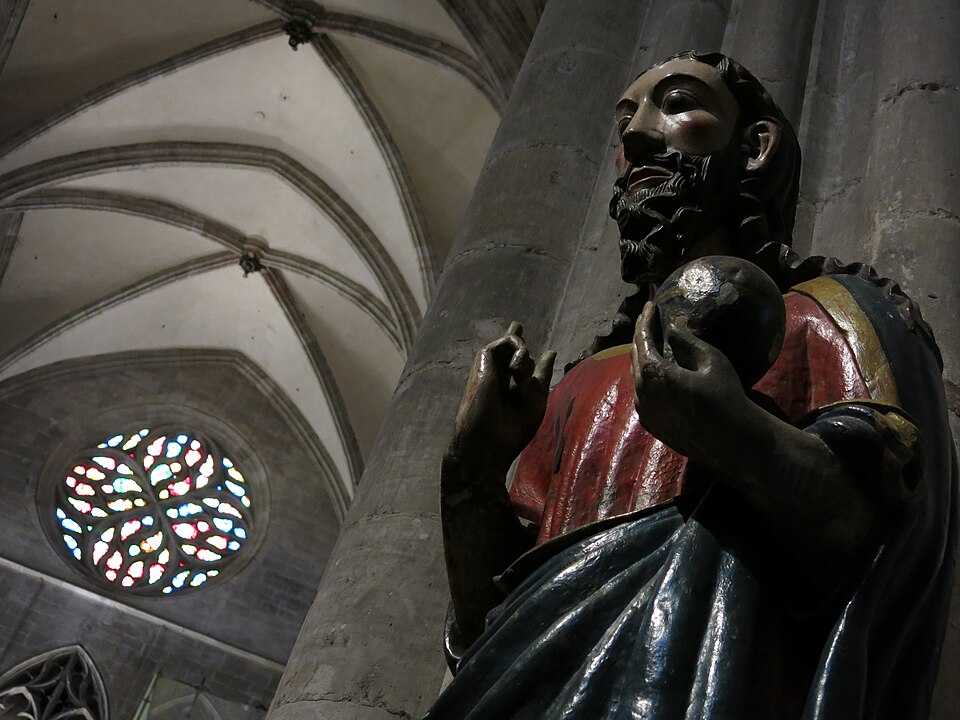
Medieval image of El Salvador, Oviedo Cathedral. Photo: Carlos Teixidor Cadenas / Wikimedia Commons (CC BY-SA 4.0).
Pope Saint John Paul II prayed before this image during his visit to Asturias on 20 August 1989.