


Holy Chamber of Oviedo Cathedral
The Holy Chamber is one of the oldest and most emblematic spaces in the Cathedral of San Salvador of Oviedo. Built during the period of the Asturian monarchy, it eventually became the great reliquary of the Sancta Ovetensis and one of the places that best explains Oviedo’s religious importance during the Middle Ages.
Its interior brings together Pre-Romanesque architecture, Romanesque sculpture and some of the best-known pieces in the cathedral treasury. The Holy Chamber forms part of the Monuments of Oviedo and the Kingdom of Asturias, inscribed on the UNESCO World Heritage List.
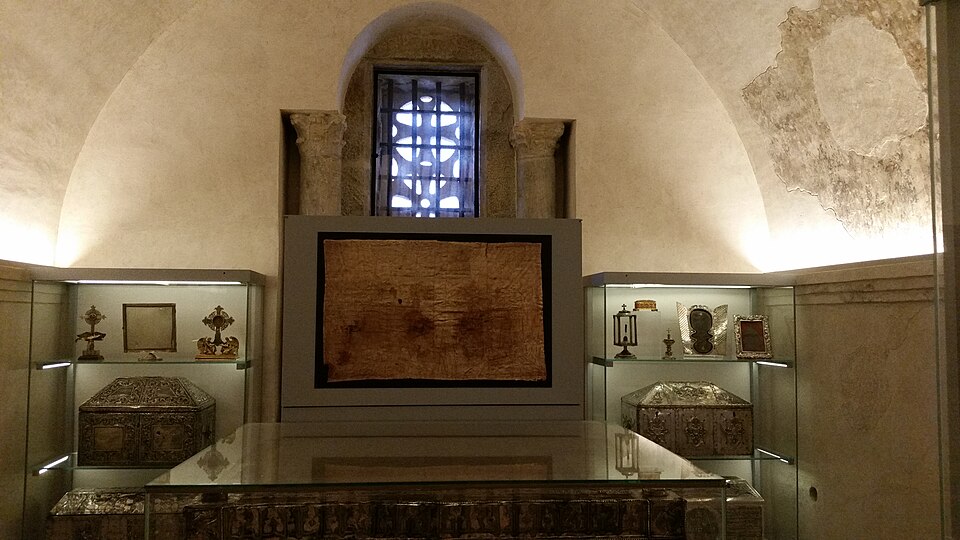
Interior of the Holy Chamber of Oviedo Cathedral. Photo: amateur photography by michel / Wikimedia Commons, CC BY 2.0.
Origins and history of the Holy Chamber
For a long time, the construction of the Holy Chamber was attributed to the reign of Alfonso II the Chaste. More recent archaeological research places its construction in the reign of Alfonso III (866–910), during the final period of the Asturian monarchy before the royal court moved to León.
Its original function was associated with a space of a martyrial and funerary nature. Over time it became integrated into the San Salvador complex and was used to safeguard the treasure and relics that made Oviedo Cathedral famous.
A two-storey building
The Holy Chamber has a structure of two superimposed levels. The lower level is the Crypt of Saint Leocadia, while the upper level is the Chapel of Saint Michael, which houses the celebrated Romanesque sculptural ensemble.
Crypt of Saint Leocadia
The lower floor is the Crypt of Saint Leocadia. It retains its funerary character and forms the lower part of this remarkable Pre-Romanesque building.
Chapel of Saint Michael
The upper level is the Chapel of Saint Michael, the space generally identified with the Holy Chamber. Its Pre-Romanesque structure was altered in the 12th century, when the nave’s original wooden roof was replaced by a barrel vault.
The Romanesque Apostolate
The 12th-century refurbishment introduced a barrel vault reinforced by transverse arches. The supports for this new vault gave rise to one of the outstanding sculptural ensembles of Spanish Romanesque art: the Apostolate of the Holy Chamber.
The apostles are arranged in pairs on the column shafts. The iconographic programme presents them symbolically as “pillars of the Church”. The ensemble was completed by a Calvary above the doorway, from which the stone-carved heads of Christ, the Virgin Mary and Saint John survive.
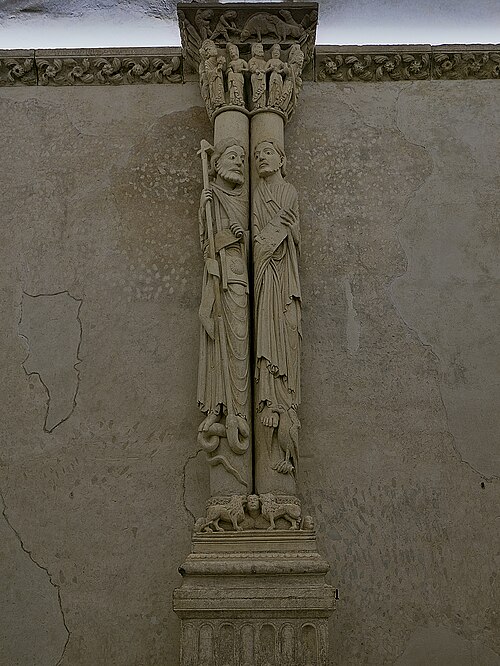
Saint James the Greater and Saint John the Evangelist, Apostolate of the Holy Chamber. Photo: Jl FilpoC / Wikimedia Commons, CC BY-SA 4.0.
The treasure and relics of the Sancta Ovetensis
The fame of the Holy Chamber is inseparably linked to the collection of relics and precious metalwork preserved by the Cathedral. For centuries they were among the main reasons for pilgrimage to Oviedo.
Among the best-known pieces are the Holy Ark, the Holy Shroud, the Cross of the Angels, the Victory Cross and the Agate Casket.
- Holy Shroud of Oviedo →
- Holy Ark →
- Cross of the Angels →
- Victory Cross →
- Relics of Oviedo Cathedral →
The Agate Casket
The Agate Casket is a reliquary donated to the Cathedral in 910 by Fruela II and his wife Nunilo. Its decoration combines gold sheets, agate plaques, gemstones and enamels, making it one of the outstanding works in the Cathedral’s medieval treasury.
The destruction of 1934 and reconstruction
In October 1934, during the Asturian Revolution, an explosion destroyed the Holy Chamber and also brought down one side of the cloister. Work immediately began to clear the rubble and recover architectural elements, relics and precious objects.
The architect Alejandro Ferrant and art historian Manuel Gómez-Moreno took part in these initial recovery efforts. The Holy Chamber was reconstructed between 1939 and 1942 by architect Luis Menéndez Pidal and Asturian sculptor Víctor Hevia.
The Holy Chamber and pilgrimage
The concentration of relics made Oviedo an important pilgrimage destination. Pilgrims travelling towards Santiago could visit San Salvador to venerate the relics of the Sancta Ovetensis.
This tradition is reflected in the well-known saying: “Whoever goes to Santiago and not to the Saviour visits the servant and leaves the Lord behind.”
Oviedo Cathedral is also closely linked to the Camino Primitivo, the pilgrimage route to Santiago that begins in the Asturian capital.