Oviedo dressed for the occasion
Documents from 1537 describe solemn processions through the streets, tapestries hanging from balconies and torches burning day and night at the Cathedral.


Every September, Oviedo Cathedral of San Salvador celebrates one of the city’s oldest religious and historical traditions: the Jubilee of the Holy Cross, popularly known as the Perdonanza.
The celebration is closely linked to the relics kept in the Holy Chamber (Cámara Santa), the Cross of the Angels, the Cross of Victory and the Holy Shroud. It also lies behind today’s San Mateo festivities, which grew out of the arrival of pilgrims and the celebrations that accompanied the Jubilee.
| Dates | 14 to 21 September 2026 |
|---|---|
| Venue | Oviedo Cathedral of San Salvador |
| Jubilee Mass | Every day at 6:30 pm, in the central nave |
| 21 de septiembre | Solemn Mass at 12:00 noon, in addition to the Jubilee celebration |
| Cross of the Angels | Displayed on the High Altar during the Jubilee celebrations |
| Holy Shroud | Uncovered in the Holy Chamber throughout the Jubilee and displayed before the High Altar on 14 and 21 September |
The origins of the Perdonanza are linked to Oviedo’s role as a major centre for the veneration of relics during the Middle Ages. The Cathedral became known as Sancta Ovetensis because of the extraordinary collection of relics preserved in the Holy Chamber.
The popular name Perdonanza is linked to the penitential and Jubilee character of the celebration. In the Catholic tradition, the Jubilee offers the possibility of obtaining a plenary indulgence under certain conditions.
In 2026, obtaining the plenary indulgence requires a devout visit to the Cathedral and fulfilment of the conditions established by the Church, including sacramental confession, Communion and prayer for the Pope’s intentions, together with the Our Father and the Creed.
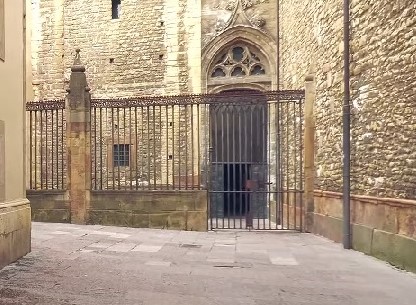
Its name is directly connected with the Perdonanza, or Jubilee of the Holy Cross. For centuries, pilgrims arriving in Oviedo to venerate the relics of San Salvador entered the Cathedral through this doorway, located in the Tránsito de Santa Bárbara and close to the High Altar.
Por ella accedían al templo para participar en el Jubileo y obtener la indulgencia concedida por la Iglesia, cumpliendo las condiciones establecidas. De ahí procede el nombre de Perdonanza Door: era la entrada tradicional de los peregrinos que acudían a San Salvador con motivo de ese tiempo de «perdón» o indulgencia jubilar.
Pilgrims arriving via the Northern Way (Camino del Norte) reached this entrance after passing near San Pelayo, San Vicente and the Corrada del Obispo. Those arriving from the Castilian plateau crossed the city to reach the Tránsito de Santa Bárbara.
The present bronze door was made by Miguel Iribertegui Eraso in 1996. Its name and location preserve the memory of the close historical relationship between the Cathedral, the Perdonanza and the pilgrims who came to Oviedo over the centuries.
One of the most distinctive sights of the Perdonanza is the red flags flying from the Cathedral tower. Their traditional purpose was to announce to the city that the Jubilee period had begun.
The custom ceased after the 2008 Jubilee of the Crosses and was revived in 2022. Since then, Oviedo mountain guide Joaquín Álvarez Sánchez has climbed to the tower spire to put the flags in place.
En 2026 se colocaron el 12 de septiembre cinco banderas rojas: una de mayor tamaño con la imagen de la Cross of the Angels y otras cuatro más pequeñas.
Before modern means of communication existed, the flags at the top of the tower acted as a genuine public announcement, telling local residents, visitors and pilgrims that the Perdonanza had begun.
One of the most interesting historical facts is that today’s San Mateo festivities in Oviedo originated in the celebrations that accompanied the Perdonanza.
For centuries, thousands of pilgrims came to Oviedo to venerate the relics and take part in the Jubilee. Their arrival gave rise to markets, celebrations and secular entertainments. The Jubilee period ended on 21 September, the feast of Saint Matthew, and over time the saint’s name came to identify the city’s main September festivities.
For a time, September also included festivities connected with Saint Eulalia, patron saint of the city and the diocese since 1639, but the celebrations associated with the end of the Jubilee eventually became more prominent.
San Mateo Festivities 2026Documents from 1537 describe solemn processions through the streets, tapestries hanging from balconies and torches burning day and night at the Cathedral.
The chronicles mention night-time fires on the Cathedral tower, music and drumbeats, reflecting the festive atmosphere that accompanied the religious celebrations.
Records survive of days when more than 20,000 documents known as “buletas” were printed for pilgrims arriving in Oviedo during the Perdonanza.
The flags, visible from different parts of the city, acted as a public signal that the Perdonanza was beginning. The tradition was revived in 2022.
21 September marked the end of the Perdonanza. The popular celebrations associated with this period eventually developed into today’s San Mateo festivities.
Aunque el Holy Shroud es hoy una de las reliquias más conocidas, el origen del Jubileo está especialmente ligado a las cruces históricas de la Catedral, sobre todo a la Cross of the Angels.
This page has been prepared mainly using historical and current information from Oviedo Cathedral and the Archdiocese of Oviedo. Times and events may be subject to change, so it is advisable to check the official sources before visiting.
History del Jubileo · Catedral de Oviedo Jubilee 2026 · Arzobispado