


Holy Shroud of Oviedo
The Holy Shroud of Oviedo is the most venerated of the relics preserved in the Holy Chamber of San Salvador Cathedral in Oviedo. It is an ancient linen cloth which, according to Christian tradition, covered the head of Jesus Christ after his death and before burial.
Its presence in Oviedo has been documented since the Middle Ages and played a decisive role in making the Cathedral an important pilgrimage centre, renowned for the abundance and significance of its relics as the Sancta Ovetensis.
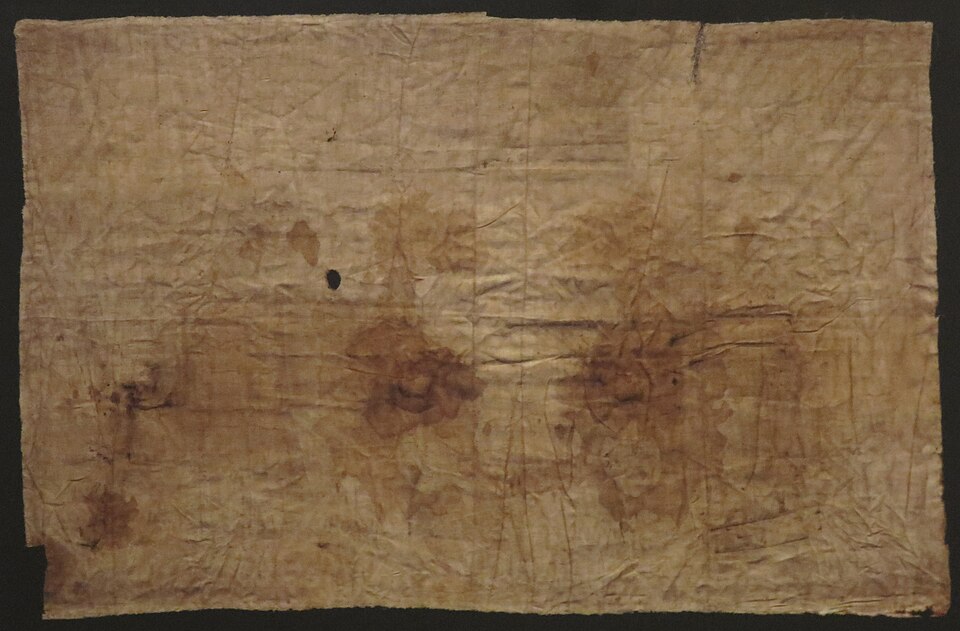
Holy Shroud of Oviedo. Photo: Reinhard Dietrich / Wikimedia Commons, CC BY-SA 4.0.
A linen cloth
The Holy Shroud is a rectangular linen cloth measuring 85.5 × 52.6 centimetres. Its yarn has a “Z” twist and it is woven in plain weave, with no dyes or finished side edges.
The cloth bears stains, folds, perforations and other traces accumulated over the course of its history. It is now kept protected by a system specially designed to aid its conservation.
The tradition of its arrival in Oviedo
Cathedral tradition places the beginning of the relics’ journey in Jerusalem, following the conquest of the city by the Persian king Khosrow II in 614. The chest containing them is said to have travelled across the Mediterranean, passing through Alexandria and Carthage before reaching the Iberian Peninsula.
From Cartagena it is said to have been taken to Seville and later to Toledo. After the Muslim invasion of 711, the relics are traditionally believed to have been carried north and hidden for a time on Mount Monsacro, near Oviedo.
Finally, during the reign of Alfonso II the Chaste (791–842), the collection was transferred to Oviedo. This traditional account of its earlier journey should be distinguished from the surviving historical documentation, which provides firmer evidence for the medieval presence of the Shroud in the Cathedral.
The opening of the Holy Ark in 1075
One of the key sources for the history of the Holy Shroud is the Record of the Opening of the Holy Ark, preserved in the Cathedral Chapter Archive. The ark was solemnly opened on 13 March 1075 in the presence of King Alfonso VI, bishops and members of the royal court.
The list of relics includes the Latin expression “de sudario Domini”, referring to the “Shroud of the Lord”. The document is one of the principal medieval references to the relic preserved in Oviedo.
The importance of the collection of relics kept in the Holy Chamber made Oviedo a pilgrimage stop and helps explain the city’s historic connection with the routes to Santiago and the Primitive Way.
Studies carried out on the Shroud
The cloth has been subjected to various analyses of its weave, stains, particles, folds and other characteristics. Studies publicised by the Cathedral include palynological, haematological and morphogeometric research.
Some research teams have interpreted certain stains as human blood and other fluids and have proposed reconstructions of how the cloth may have been placed around the head of a corpse. Pollen, traces of wax, particles and marks associated with the historical events experienced by the relic have also been described.
The Holy Shroud and the Shroud of Turin
Since the 20th century, comparisons have been made between the Holy Shroud of Oviedo and the Shroud of Turin. Some researchers have pointed to similarities in the distribution of certain stains and have proposed the hypothesis that both cloths may have been associated with the same person.
This hypothesis has led to numerous studies and publications, but there is no universally accepted historical or scientific proof that conclusively identifies the man associated with both cloths as Jesus of Nazareth.
When can the original Holy Shroud be seen?
For conservation reasons, visitors normally see an exact replica during a visit to the Holy Chamber. The Cathedral displays the original only during certain periods of the year:
- Holy Week.
- Easter Week.
- During the Holy Cross Jubilee, from 14 to 21 September.
In addition, the Holy Shroud is traditionally shown from the high altar and used to impart a blessing on certain dates, including Good Friday and 14 and 21 September.