


The Holy Ark of Oviedo Cathedral
The Holy Ark is one of the great historical and religious treasures of the Holy Chamber of San Salvador Cathedral in Oviedo. For centuries it was associated with the safekeeping of an extraordinary collection of relics, foremost among them the Sudarium of Oviedo.
Its solemn opening in 1075, in the presence of King Alfonso VI and several bishops and members of the royal court, is one of the key episodes in the Cathedral’s history. The veneration of the relics played a decisive role in establishing Oviedo as a medieval pilgrimage destination and in spreading the name Sancta Ovetensis.
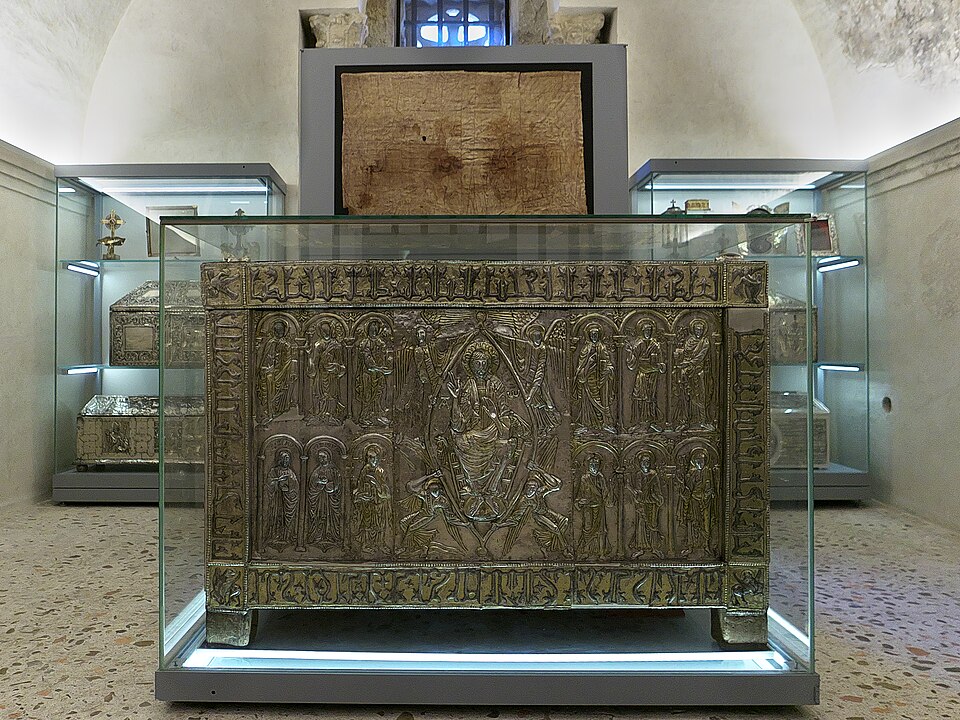
Holy Ark of Oviedo Cathedral. Photo: Jl FilpoC / Wikimedia Commons, CC BY-SA 4.0.
The Holy Ark
The Holy Ark is a large reliquary preserved in the inner chamber of the Holy Chamber. Its importance lies not only in its artistic value, but especially in its close connection with relics that Christian tradition associated with Christ, the Virgin Mary, the Apostles and numerous saints.
The feature that immediately draws attention today is its covering of embossed silver, a Romanesque work that transformed the ancient reliquary chest into one of the finest examples of medieval metalwork preserved in the Cathedral.
The tradition of the Ark’s journey
Cathedral tradition places the beginning of the relics’ journey in Jerusalem. Following the invasion of the city by the Persian king Khosrow II in 614, Christians are said to have left the city carrying a chest containing numerous relics.
According to this traditional account, the Ark passed through Egypt and North Africa before reaching the Iberian Peninsula through Cartagena. It was later taken to Seville and then to Toledo, at that time one of the principal religious centres of the Visigothic kingdom.
After the Muslim invasion of the Iberian Peninsula in 711, the relics are said to have been taken north for safekeeping. Tradition holds that they remained hidden for a time on Mount Monsacro, south of Oviedo.
The arrival in Oviedo
According to tradition, during the reign of Alfonso II the Chaste (791–842), the relics were transferred from Monsacro to Oviedo, where they became associated with the religious complex of San Salvador.
From then on, the history of the relics and that of the Holy Chamber became closely intertwined. Over time, the Holy Chamber became the principal space for safeguarding and venerating the Cathedral’s sacred treasure.
The traditional account of the long journey from Jerusalem should be distinguished from the surviving medieval documentary evidence. Among the latter, the document relating to the opening of the Holy Ark in the 11th century is particularly significant.
The solemn opening of the Holy Ark in 1075
On 13 March 1075, the Holy Ark was solemnly opened in the presence of King Alfonso VI, several bishops and members of the royal court. A document known as the Act of the Opening of the Holy Ark survives from this event in the Cathedral Chapter Archive.
The document contains an extensive list of relics attributed to Christ, the Virgin Mary, the Apostles and numerous saints. Among them is the notable reference “de sudario Domini”, referring to the Sudarium of the Lord.
The 1075 act is an essential source for understanding the importance that the relics of Oviedo had already acquired in the Middle Ages and is one of the most notable documents preserved in the Chapter Archive.
The relics of the Holy Ark
The medieval list attributed an extraordinary collection of relics to the Holy Ark. The most prominent is the Sudarium of Oviedo, the cloth which, according to Christian tradition, covered the head of Jesus Christ after his death.
Alongside the Sudarium, relics connected with Christ, the Virgin Mary, the Apostles and various saints were listed. The number and significance attributed to this collection help explain the fame of San Salvador Cathedral as one of the great relic shrines of medieval Christendom.
The silver covering
Following the opening of 1075, the Ark was covered with embossed silver plates. The result is an important work of Romanesque metalwork, designed to enhance the dignity of the reliquary and its contents.
Its decoration presents a religious iconographic programme through figures and scenes worked into the metal plates. The covering transformed the ancient relic chest into a monumental object worthy of the extraordinary veneration its contents had acquired.
Today the Holy Ark occupies a prominent position in the centre of the inner chamber of the Holy Chamber, alongside other major treasures of the Cathedral.
The Holy Ark and pilgrimages to Oviedo
The fame of the relics preserved at San Salvador made Oviedo an important destination for medieval pilgrims. Many travellers heading towards Santiago de Compostela made a detour to venerate the relics of Oviedo Cathedral first.
This tradition lies behind Oviedo’s close connection with the Camino de San Salvador and the Camino Primitivo. The importance of the relics also lies at the origin of the Cathedral’s special jubilee tradition, represented today by the Jubilee of the Holy Cross, or Perdonanza.
The Holy Ark is therefore much more than a work of metalwork: it is one of the key elements for understanding Oviedo’s religious history, the medieval prestige of its Cathedral and the development of pilgrimages to San Salvador.