


Relics of Oviedo Cathedral
The Holy Chamber of the Cathedral of San Salvador in Oviedo has housed one of the most celebrated collections of relics in Western Christianity since the Middle Ages. Their religious importance led the Cathedral to become known as the Sancta Ovetensis and made Oviedo a major pilgrimage destination.
The historical core of this treasure is associated with the Holy Ark, whose contents were solemnly examined in 1075 in the presence of King Alfonso VI and several bishops. Among the relics traditionally associated with the ark, the Holy Shroud stands out as the most venerated relic preserved in the Cathedral.
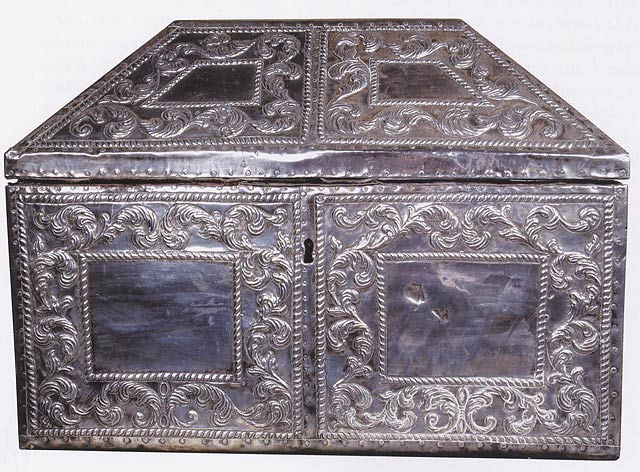
Reliquary casket of Saint Eulogius and Saint Leocritia, Holy Chamber of Oviedo Cathedral. Photo: Bocachete / Wikimedia Commons, public domain.
The Sancta Ovetensis
The abundance and prestige of the relics preserved at San Salvador meant that Oviedo Cathedral became known from ancient times as the Sancta Ovetensis. For centuries, pilgrims from many different places came to venerate them before continuing their journey to Santiago de Compostela.
Cathedral tradition places the arrival in Asturias of a chest of relics from the Holy Land after a long journey through the Mediterranean and the Iberian Peninsula. According to this tradition, after passing through places such as Cartagena, Seville and Toledo, the relics were taken north and remained protected for a time on Monsacro before being transferred to Oviedo.
The Holy Ark and its opening in 1075
The Holy Ark is the great reliquary of the Holy Chamber. On 13 March 1075, it was solemnly opened in the presence of King Alfonso VI, members of the royal court and several bishops. The record of that ceremony, preserved in the Cathedral Archive, contains an extensive list of relics.
Following that opening, the ark was covered with embossed, nielloed, engraved and partially gilded silver plates, transforming it not only into a container for relics but also into one of the finest surviving examples of Romanesque metalwork in Spain.
Among the relics listed in the documentary tradition of the ark are objects associated with Christ, the Virgin Mary, the Apostles and numerous saints. Of all these relics, the Holy Shroud acquired exceptional importance.
The main relics
The Holy Shroud
The Holy Shroud of Oviedo is the most venerated relic in the Holy Chamber. It is a linen cloth which, according to Christian tradition, covered the head of Jesus Christ after his death. Its presence in Oviedo has been documented since the Middle Ages and it features prominently in the list of relics associated with the opening of the Holy Ark in 1075.
The True Cross
The Cathedral preserves relics traditionally identified as fragments of the True Cross (Lignum Crucis), the cross on which Christ was crucified. One of them is associated with the so-called Christ of Nicodemus, a 12th-century work containing a fragment beneath rock crystal. In the 20th century, a reliquary cross made by the Asturian priest and goldsmith Félix Granda Buylla was also added to house another fragment of the True Cross.
The Holy Thorn
Among the relics of the Passion is also a Holy Thorn, traditionally identified as coming from Christ's Crown of Thorns. Its present reliquary was likewise created in the 20th century by Félix Granda Buylla.
Saint Peter's sandal
One of the most unusual pieces in the collection is the relic of the sandal of Saint Peter's right foot. A special reliquary was made for it in the 17th century, allowing the object to be viewed while remaining protected inside.
Saint Eulogius and Saint Leocritia
Among the relics closely associated with the history of the Holy Chamber, those of Saint Eulogius and Saint Leocritia, 9th-century martyrs of Córdoba, occupy a particularly important place. Their remains were transferred to Oviedo in 884, during the reign of Alfonso III.
The Crypt of Saint Leocadia, located on the lower floor of the Holy Chamber, housed their bodies. Centuries later, in 1742, a casket was made to contain their remains, and it now forms part of the Cathedral's collection of reliquaries.
Other reliquaries and relics
The Cathedral's treasury of relics grew over the centuries. New objects and reliquaries intended to preserve remains attributed to saints and objects associated with Christian tradition were added to those connected with the Holy Ark.
Among them are a casket containing remains of Saint Julian and Saint Serrano, added at the end of the 16th century; silver and coral boxes dating from the 17th century; a ciborium containing relics attributed to the Virgin Mary and Saint John the Baptist; and a casket made in 1742 for the remains of Saint Eulogius and Saint Leocritia.
The collection is completed by the great treasures donated by the Asturian monarchy: the Cross of the Angels, donated by Alfonso II in 808; the Victory Cross, presented by Alfonso III and Jimena in 908; and the Agate Casket, donated by Fruela II and Nunilo in 910. Although these works possess their own historical and artistic significance, they form an inseparable part of the extraordinary treasury preserved in the Holy Chamber.
The relics and pilgrimage to Oviedo
The fame of the relics of San Salvador made Oviedo one of the great pilgrimage centres of medieval Spain. Many pilgrims travelling to Santiago de Compostela made a detour to the Asturian capital to venerate the treasures of the Holy Chamber.
This tradition is reflected in the well-known medieval saying: “Whoever goes to Santiago and not to the Saviour, visits the servant and leaves the Lord behind”, an expression of the importance that a visit to San Salvador in Oviedo acquired within the pilgrimage routes to Santiago.
The close relationship between the relics, the Cathedral and pilgrimage also explains the historical importance of the Camino Primitivo, or Original Way, whose origins are associated with the route from Oviedo to Santiago de Compostela.
The relics today
The principal relics and historic objects continue to be preserved in the Holy Chamber. Some can be viewed during cultural visits to the Cathedral, while others are subject to special conservation measures.
The most significant example is the Holy Shroud. A facsimile is normally displayed, while the original is exhibited only during certain periods of the year: Holy Week, Easter Week and from 14 to 21 September, with the latter period coinciding with the Jubilee of the Holy Cross, or Perdonanza.
The collection in the Holy Chamber helps explain why Oviedo was known for centuries as the Sancta Ovetensis: a place where art, history, devotion and pilgrimage are closely intertwined.