


High Altarpiece of Oviedo Cathedral
The High Altarpiece of San Salvador Cathedral in Oviedo dominates the Main Chapel and is one of the most important works of art in the church. Created in the early 16th century, it is a major transitional work between the late Gothic period and the new Renaissance forms.
Its complex architecture frames numerous scenes devoted mainly to the life of Christ, forming a great visual narrative that dominates the cathedral sanctuary.
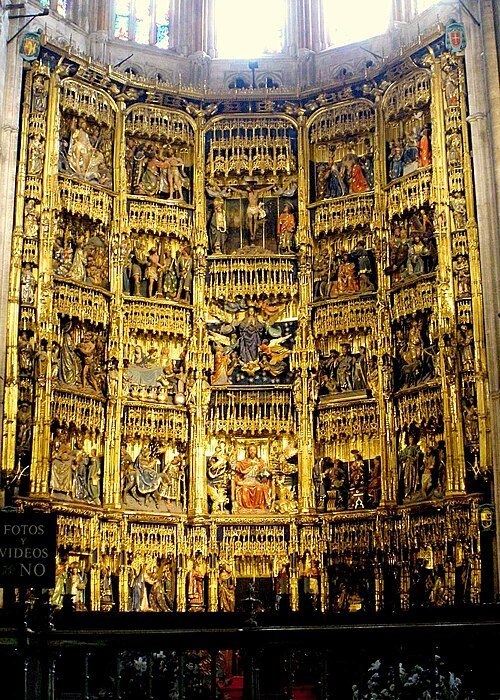
Front view of the High Altarpiece. Photograph: Zarateman, CC0 / public domain (Wikimedia Commons).
History of the High Altarpiece
The Main Chapel, built between 1382 and 1412 on a pentagonal plan, is the oldest part of the Gothic church. Work on the great altarpiece that now dominates it began in 1512, at a time when the cathedral was completing some of its most important monumental features.
The sculptural work continued until 1518. Several years later, the polychromy was carried out between 1529 and 1531, completing the monumental and luminous appearance that characterises the ensemble.
The artists
The altarpiece was the work of several masters of European origin. In 1512, Giralte de Bruselas, Guillén de Holanda and Esteban de Amberes began the project. Juan de Valmaseda joined them in 1516, and the ensemble was completed in 1518.
The participation of masters associated with different artistic traditions helps explain the altarpiece’s formal richness and its transitional character between the Late Gothic world and the innovations of the Renaissance.
A monumental architecture in wood
The altarpiece occupies the rear of the Main Chapel and adapts to its pentagonal layout. Its structure is organised vertically and horizontally into numerous compartments containing sculptures and reliefs.
This arrangement makes it possible to view the ensemble as a true architecture within the architecture of the cathedral: pinnacles, canopies, tracery and other ornamental elements frame the scenes and draw the eye towards the central area.
The abundance of figures and details rewards close observation, revealing features that can easily go unnoticed when the altarpiece is viewed only from the nave.
What the High Altarpiece depicts
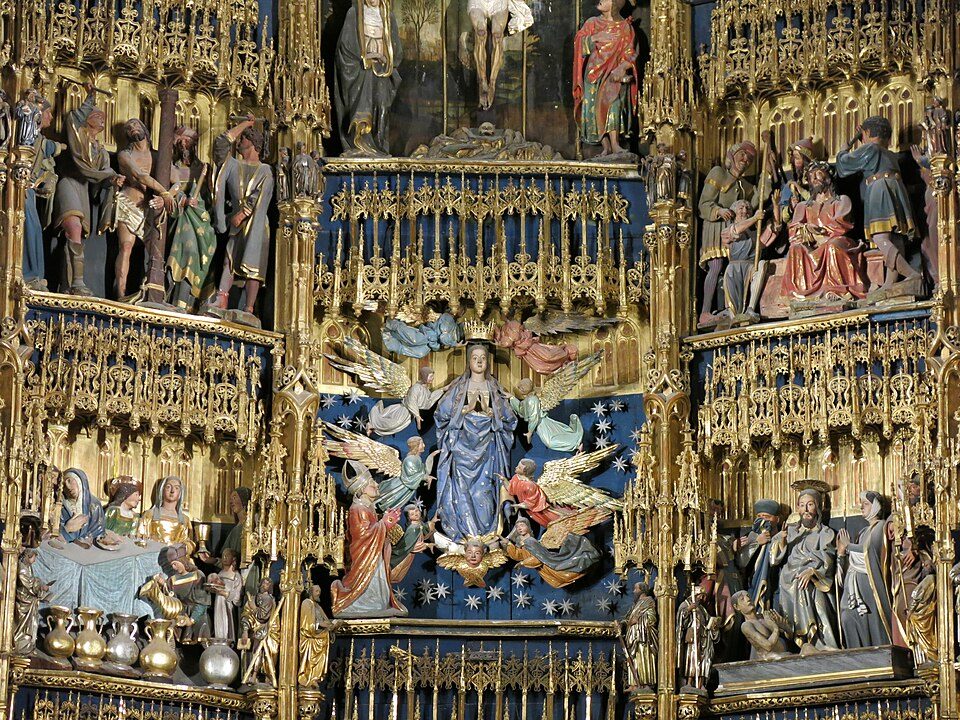
Detail of the Virgin Mary in the High Altarpiece of Oviedo Cathedral.
Photo: Enric · Wikimedia Commons · CC BY-SA 4.0
The iconographic programme of the altarpiece is primarily devoted to narrating the life of Christ. The different scenes are distributed throughout the ensemble, creating a visual sequence intended both to embellish the Main Chapel and to convey the principal episodes of the Christian tradition.
The Assumption of the Virgin also occupies a prominent position in the central section. This representation replaced the cathedral’s former Gothic altarpiece, from which a late-15th-century panel attributed to Pedro de Mayorga, known as the Master of Palanquinos, is preserved in the Diocesan Museum.
The altarpiece thus combines episodes, figures and symbols in a composition designed to be viewed from different points in the sanctuary and central nave.
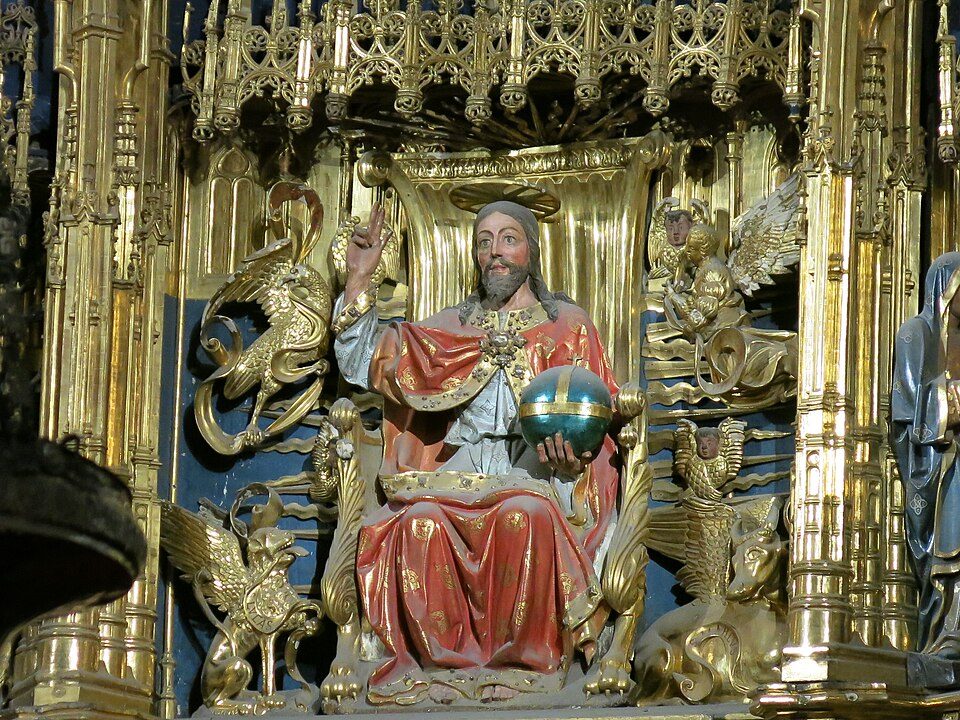
Detail of Christ the Saviour in the High Altarpiece.
Photo: Enric · Wikimedia Commons · CC BY-SA 4.0
Gilding and polychromy
The sculptural work was not fully completed when the carving ended in 1518. Between 1529 and 1531, the polychromy was applied, a task attributed to León Picardo and Miguel Bingueles.
Colour and gilding contribute decisively to the visual effect of the altarpiece. The light entering the Main Chapel highlights the reliefs, figures and architectural elements, enhancing the sense of depth and ornamental richness.
Historical content checked primarily against heritage information published by the Chapter of Oviedo Cathedral.