


The choir of Oviedo Cathedral
For centuries, the choir occupied a prominent place in the central nave of the Cathedral of San Salvador in Oviedo. It was the area reserved for the cathedral chapter for prayer and liturgical services and was furnished with an important set of Late Gothic choir stalls, one of the great works in wood created for the church at the end of the 15th century.
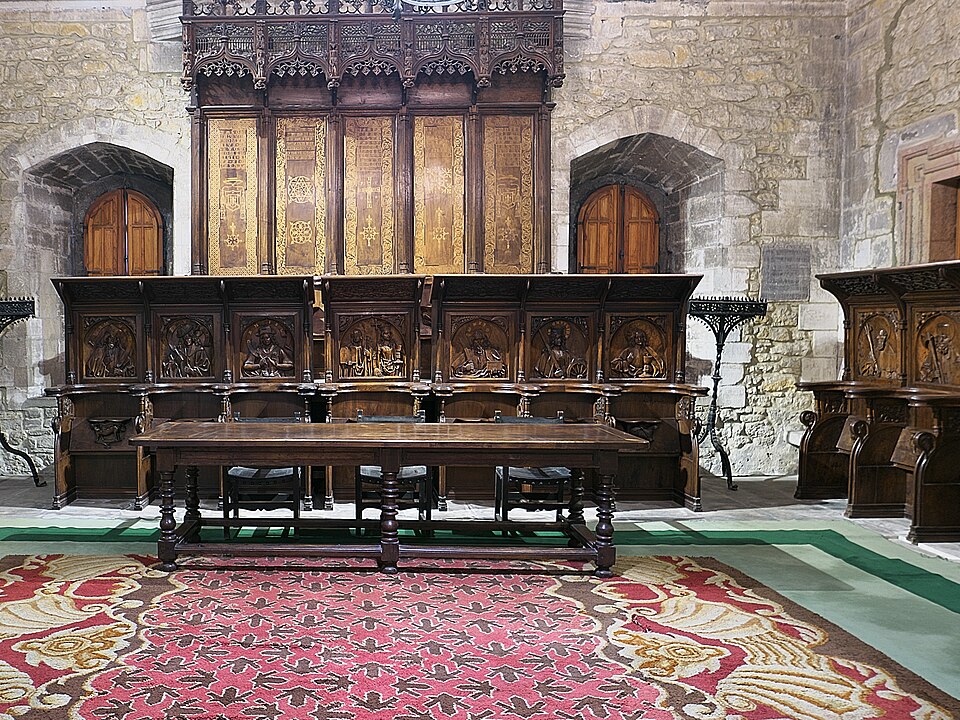
The choir of Oviedo Cathedral. Photograph: Jl FilpoC / Wikimedia Commons. Licence: CC BY-SA 4.0.
A choir from the late 15th century
The choir stalls were made in the final decades of the 15th century and are associated with the episcopate of Juan Arias del Villar (1487–1498), a period in which the completion of the Cathedral’s Gothic naves advanced decisively.
Oviedo Cathedral attributes the choir stalls to the sculptor Alejo de Vahía and his workshop, dating them approximately to 1491–1497. Their artistic language reflects a strong Late Gothic tradition and clear Flemish influence, visible both in the figures and in the richness of the ornamental details.
Where the choir was located
The former choir was not located in the chancel, as a present-day visitor might imagine. It occupied part of the central nave, in front of the crossing, forming a distinct enclosure within the large Gothic interior.
This arrangement was common in many Spanish cathedrals: the canons gathered in an enclosed area, arranged with two tiers of seats and visually separated from the rest of the nave by architectural structures and a screen.
The Gothic choir stalls
The stalls were arranged in two tiers: upper and lower choir stalls. Sources from the Cathedral itself state that the ensemble commissioned by Arias del Villar consisted of forty-four upper stalls and forty-six lower stalls.
The stalls were made mainly of walnut wood. The surviving pieces include back panels, openwork canopies, marquetry and abundant carved decoration, revealing the high quality achieved by the workshops involved in the ensemble.
What is a choir stall?
A choir stall is one of the individual seats that make up a set of choir stalls. In cathedrals they were intended for members of the chapter and were arranged in an orderly fashion around the choir enclosure.
Carvings, marquetry and scenes
One of the most interesting features of the choir stalls is the variety of their decoration. The surviving remains combine religious motifs with secular subjects, something common in choir sculpture at the end of the Middle Ages.
- Apostles, saints and prophets.
- Plant motifs and ornament in the Gothic tradition.
- Real animals and fantastic creatures.
- Scenes related to hunting and other secular subjects.
- Marquetry on the back panels, including heraldic motifs and the Cross of the Angels.
The combination of these themes makes the stalls an especially valuable testimony to the visual culture of the late 15th century, showing how religious, symbolic and everyday subjects could coexist within the decoration of a single ensemble.
The dismantling of the choir in 1901
The Cathedral interior changed profoundly at the beginning of the 20th century. In 1901, the choir occupying the central nave was dismantled as part of a refurbishment promoted during the episcopate of Ramón Martínez Vigil to open up the interior view of the church.
Other elements associated with the choir were also dismantled when the enclosure disappeared. The former Baroque organs were lost, while the choir stalls were moved and distributed among different parts of the Cathedral. The central arch of the retrochoir, a work by Juan de Badajoz the Elder, was reused as a doorway at the entrance to the Baroque staircase of the Holy Chamber.
What survives today
The choir stalls have not survived intact. After they were dismantled, some of the stalls were installed in the Chapel of Saint Barbara. The revolutionary events of 1934 caused serious damage in various parts of the Cathedral and also affected these pieces.
The surviving remains were later recovered and restored. Today they can be seen in the Chapter House, where five upper stalls and twenty-three lower stalls have been brought together.
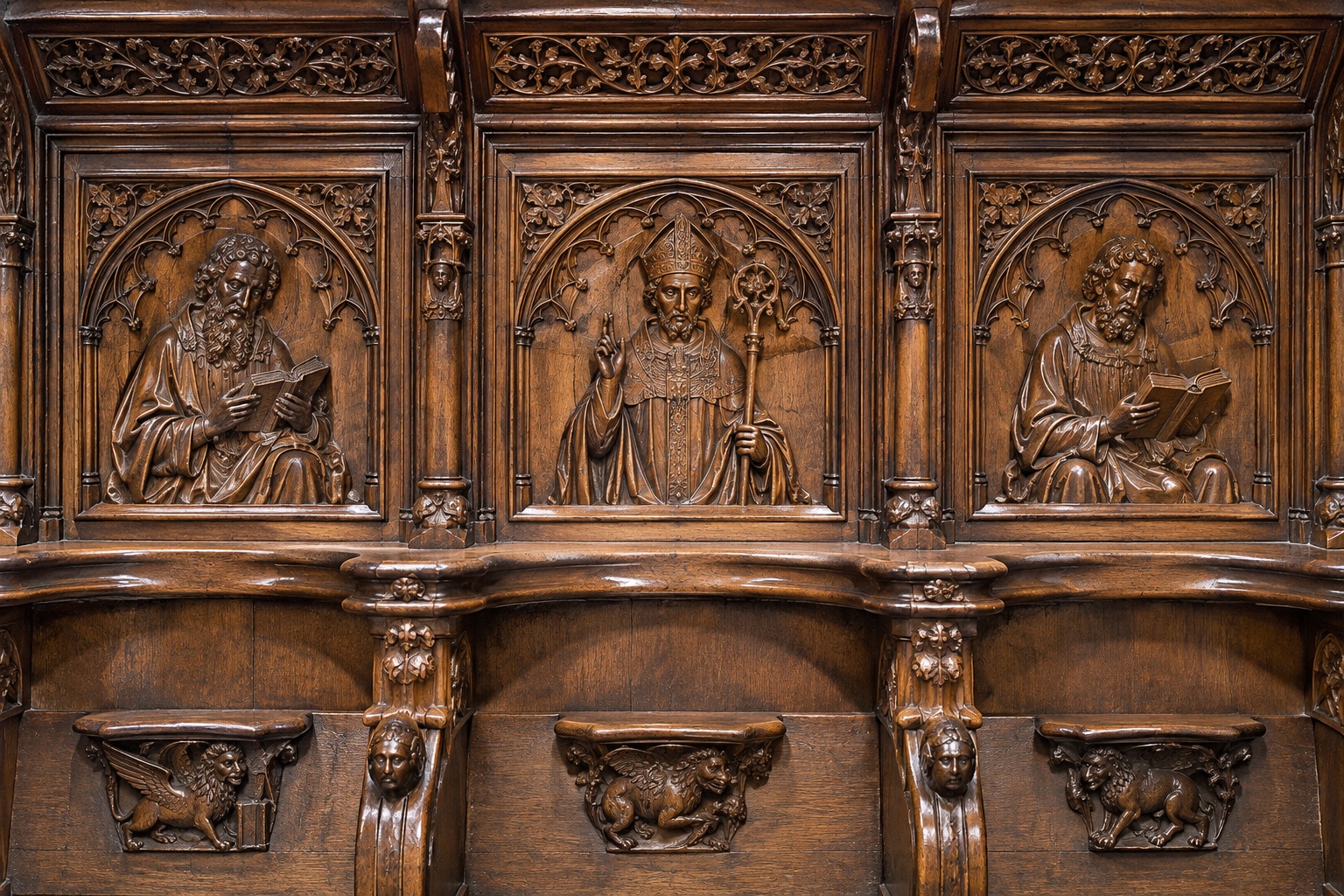
Detail of the choir stalls: the surviving remains reveal the carving and decoration of the Late Gothic ensemble
The former choir screen
The enclosure was accompanied by a Gothic screen that helped define the choir within the nave. It was commissioned by Bishop Juan Daza, who held the see of Oviedo from 1498 to 1502.
Four sections of that screen survive, with bars, plant decoration, ogee arches, pinnacles and heraldic motifs. These remains are associated with the Chapter House and cloister area.
A work that helps reconstruct the Cathedral’s former interior
Although the choir no longer occupies its original location, the surviving pieces help us understand what the interior of Oviedo Cathedral looked like before the 20th-century alterations. The choir stalls are also one of the principal surviving examples of Late Gothic wood sculpture in the Cathedral.
Their fragmentary condition has also attracted scholarly interest: several studies have used photogrammetry and three-dimensional reconstruction to investigate how the complete ensemble may have looked in its original location.