


Organ of Oviedo Cathedral
At the west end of the central nave of the Cathedral of San Salvador in Oviedo stands one of the great historic instruments of Asturian organ building: the organ built by Aquilino Amezúa at the beginning of the 20th century. Its monumental pipe façade and its position beneath the rose window form one of the most distinctive views inside the Cathedral.
The present instrument was built in the workshops of Aquilino Amezúa in Azpeitia and was completed in 1906. It belongs to the Romantic-symphonic organ tradition and is an outstanding example of the work of one of the most important Spanish organ builders of his time.
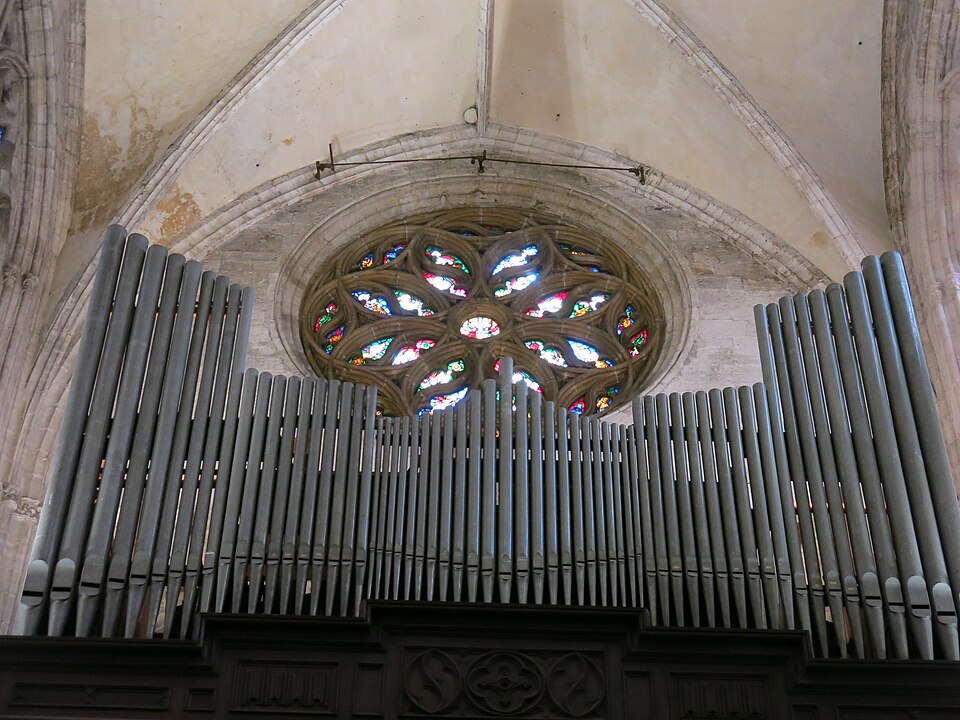
Organ of Oviedo Cathedral y rosetón. Foto: Enric / Wikimedia Commons (CC BY-SA 4.0).
A great organ for Oviedo Cathedral
The organ that now stands at the west end of the central nave was built by Aquilino Amezúa in his workshops in Azpeitia. Historical documentation dates its construction to between 1903 and 1905, and a description of the new instrument was published in 1906; the Cathedral itself dates its construction to that year.
Its installation was connected with the major changes made to the interior of San Salvador at the beginning of the 20th century. Until 1901, a choir occupied the first two bays of the nave and was associated with two Baroque organs. After it was dismantled, a new arrangement was adopted and Amezúa’s great organ was installed in its present position at the west end of the church.
Aquilino Amezúa, master organ builder
Aquilino Amezúa y Jaúregui was a key figure in Spanish organ building in the late 19th and early 20th centuries. His instruments incorporated the expressive and technical possibilities characteristic of the Romantic-symphonic organ.
The Oviedo organ belongs to the builder’s mature period. Historical documentation highlights the richness of its stops, its powerful reed section and its variety of tone colours, as well as technical innovations designed to expand the resources available to the organist.
Features del órgano
The instrument has three manuals and a pedalboard. Its tonal design follows the Romantic aesthetic, ranging from soft, expressive sounds to powerful combinations suited to the large space of the cathedral nave.
A description published in 1906 particularly praised its principal stops, reed section, full chorus and variety of imitative stops. It also incorporated technical features advanced for its time, including a crescendo pedal.
The case combines wood with exposed pipework. The façade is arranged in several pipe flats, while a second pipe façade in the lower section helps conceal the swell box.
Damage and restoration
The Cathedral suffered significant damage during the Spanish Civil War. The organ was subsequently restored by Organería Española, S.A. (OESA), an intervention that introduced modifications to the instrument.
Despite these changes, it retains considerable historical and musical value. In 2017 it was declared a Bien de Interés Cultural (Asset of Cultural Interest), in the Movable Property category, together with ten other historic organs in Asturias.
The earlier Baroque organs
Amezúa’s instrument was not the first organ to sound in San Salvador. The Cathedral’s former choir had two Baroque organs built in 1747 and 1751 by Pedro Echevarría Alcázar, organ builder to the royal household.
At the beginning of the 20th century, when the choir occupying the first bays of the nave was dismantled, those organs were also removed and were eventually lost. Some other elements of the former choir were preserved: fragments of the choir stalls are kept in the Chapter House, and several sections of its screen were moved to the cloister.