


Stained glass windows of Oviedo Cathedral
The stained glass windows of the Cathedral of San Salvador in Oviedo are an essential part of the church’s interior appearance. Light passing through the coloured glass transforms the naves and emphasises the verticality of the Gothic architecture, creating one of the most distinctive visual effects inside the Cathedral.
The windows we see today are the result of a long history. The Cathedral had important stained glass from the 16th century onwards, but damage suffered by the building during the 20th century led to the loss of much of that work. The present windows help visitors understand the importance of light and colour within the cathedral space.
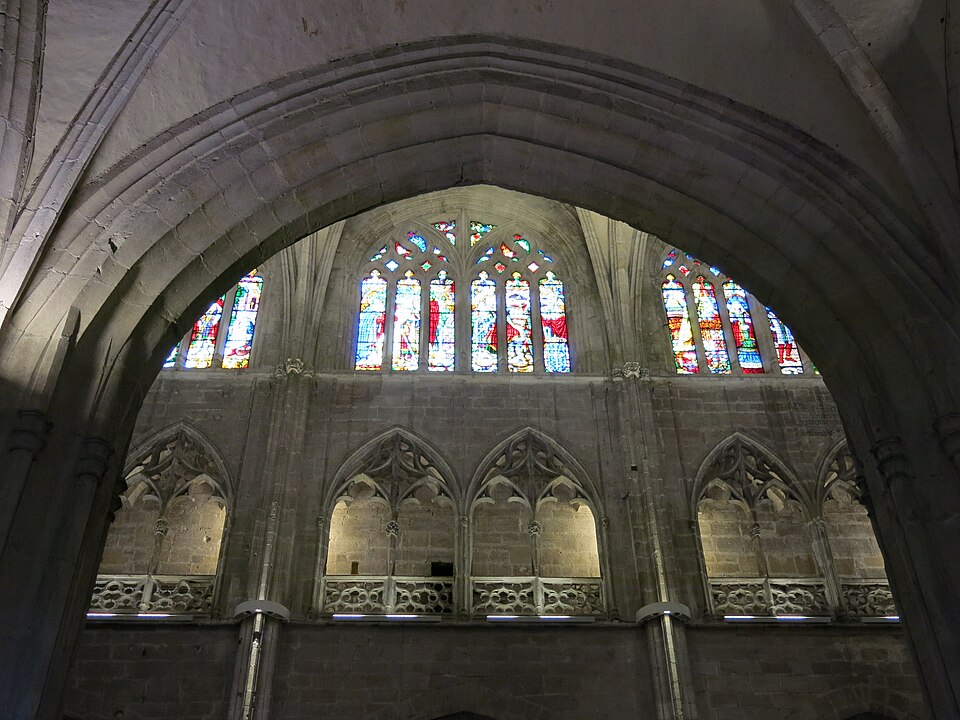
Stained glass windows of the Cathedral of San Salvador in Oviedo. Photo: Enric / Wikimedia Commons.
Historic stained glass de la Catedral
The use of stained glass was closely linked to Gothic architecture. Large windows opened in the walls allowed light into the interior while also incorporating religious images made from glass of different colours.
At Oviedo Cathedral, whose great Gothic structure developed over several centuries, stained glass helped complete the building visually. One of the most important periods in its history came at the beginning of the 16th century, when major work was undertaken to decorate the Cathedral’s windows.
Diego de Santillana and the 16th-century stained glass
In 1525, master craftsman Diego de Santillana worked on the Cathedral’s stained glass. He was one of the figures associated with the art of stained glass in early 16th-century Spain. His work took place when the Gothic construction of San Salvador was already well advanced.
Those windows combined decorative and religious functions: they filtered the outside light and helped create a distinctive atmosphere inside the church, while incorporating figurative representations characteristic of Christian art.
20th-century losses
The Cathedral’s modern history was particularly difficult for its artistic heritage. During the Asturian Revolution of 1934, the building suffered serious damage, including the destruction by explosion of the Holy Chamber. Shortly afterwards, the Spanish Civil War affected the building once again.
The stained glass did not escape these events. Much of the historic collection was lost or severely damaged, making replacement necessary during the restoration work carried out afterwards.
The present-day stained glass
Following the destruction of the 20th century, the restoration of the Cathedral included the creation of new stained glass. The windows that now fill many of the openings were made in the 1950s by the artist Santos Cuadrado.
These works largely replaced those that had been lost and restored to the naves the interplay of coloured light characteristic of a great Gothic building. Their compositions fit into the pointed windows and visually complement the Cathedral’s different spaces.
Visitors can observe them from the naves, transept and other parts of the Cathedral. Their appearance changes noticeably depending on the time of day and the outdoor lighting conditions.
Light as part of the architecture
Stained glass windows are not merely decorative elements. In Gothic architecture, light entering through coloured glass forms part of the very conception of the space. The windows visually lighten the walls and draw the eye towards the upper parts of the building.
At San Salvador, this effect combines with the pillars, pointed arches, vaults and tracery to emphasise the sense of height in the nave. As outside light passes through the stained glass, changes in intensity and colour continually alter the perception of the interior.
Looking at the stained glass therefore reveals an aspect of Oviedo Cathedral that can easily go unnoticed during a quick visit: the close relationship between architecture, light and colour that characterises the great Gothic churches.