


Chapel of Saint Eulalia at Oviedo Cathedral
The Chapel of Saint Eulalia is one of the most distinctive Baroque spaces in the Cathedral of San Salvador of Oviedo. It was conceived in the late 17th century as a monumental reliquary designed to house and display for veneration the relics of Saint Eulalia of Mérida, patron saint of the Archdiocese, the city of Oviedo and the Principality of Asturias.
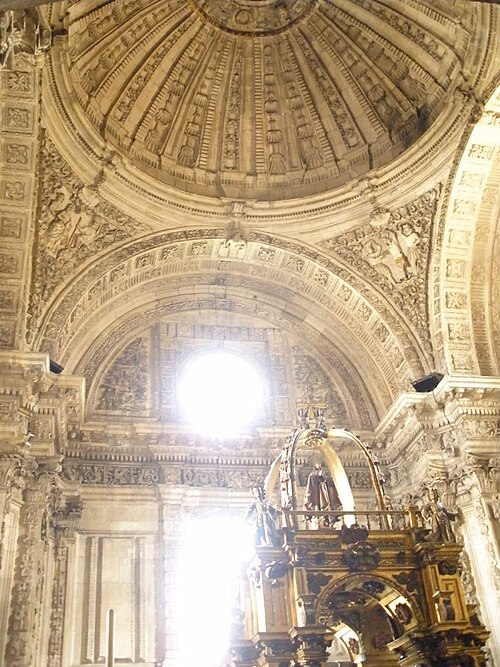
Chapel of Saint Eulalia of Mérida, Oviedo Cathedral. Photograph: Zarateman / Wikimedia Commons, CC0.
A chapel for the relics of Saint Eulalia
The relics of Saint Eulalia arrived in Asturias during the reign of Silo in the 8th century and were later transferred to Oviedo by Alfonso II. For centuries they were kept in the Holy Chamber.
In the late 17th century, Bishop Fray Simón García Pedrejón promoted the construction of a dedicated chapel where the relics could be housed with greater solemnity. The work was carried out between 1690 and 1696 under the direction of the architects from Avilés Francisco Menéndez Camina, father and son.
The new chapel was built on the north side of the Cathedral and was also conceived as the burial place of Bishop García Pedrejón himself, whose remains were transferred there in 1702.
One of the great works of Asturian Baroque architecture
In contrast to the Gothic forms that predominate throughout much of the Cathedral, the Chapel of Saint Eulalia is a fully Baroque space. Its centralized plan reflects its function as a reliquary chapel: the space is arranged around the baldachin at its centre.
The roof is dominated by a large dome resting on pendentives. The walls, pilasters, arches and vaulting feature abundant stone decoration, with vegetal and figurative motifs that create a striking ornamental effect.
The pendentives of the dome depict scenes related to the martyrdom of Saint Eulalia, inspired by a painting made by Diego Valentín Díaz in 1640 and now preserved in the Cathedral sacristy.
The central baldachin
The main focal point of the interior is the baldachin or small shrine, made in 1697 by the sculptor Domingo Suárez de la Puente and the woodworker Juan García de Ascucha. It was designed to house the casket containing the saint’s remains and to allow the faithful to walk around it.
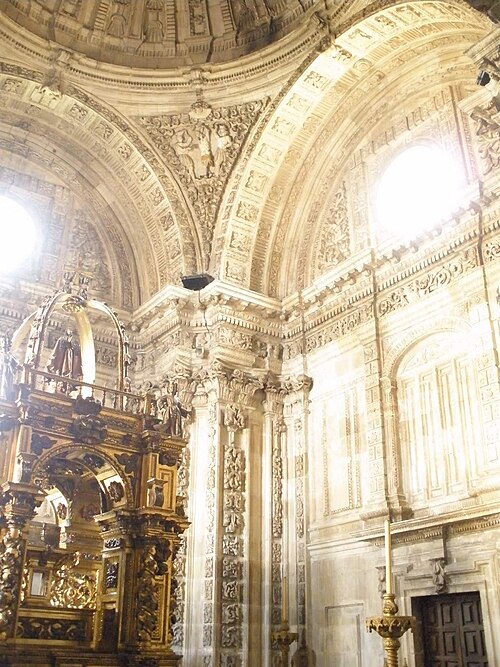
Baldachin and decoration of the Chapel of Saint Eulalia. Photograph: Zarateman / Wikimedia Commons, CC0.
The original project included even more extensive sculptural decoration. The baldachin was surrounded by twenty-two angels, only some of which survive. At the top stands the image of the Immaculate Conception, a work by Domingo Suárez de la Puente.
The casket of Saint Eulalia
At the centre of the ensemble, the martyr’s relics are kept inside an extraordinary nielloed silver casket from the Caliphal period, dating from the 11th century. The piece features oriental-style decoration and courtly scenes framed by multilobed forms, as well as an inscription in Kufic script.
The presence of a medieval Islamic object later converted into a Christian reliquary adds particular historical and artistic interest to the ensemble and makes the chapel one of the most remarkable spaces in the Cathedral.
Saint Eulalia and Oviedo
Saint Eulalia of Mérida was a young Christian martyr of the early 4th century. Her cult became extremely important in Asturias after her relics were transferred first to Asturian territory and later to Oviedo.
In the 17th century, her patronage became closely associated with Oviedo and Asturias. Her feast day is celebrated on 10 December, when the Cathedral maintains a special liturgical tradition centred on her relics.