


Vigiles Chapel of Oviedo Cathedral
The Vigiles Chapel, also known as the Chapel of the Annunciation, is one of the most distinctive spaces in the Cathedral of San Salvador of Oviedo. Conceived as the funerary chapel of Bishop Juan Vigil de Quiñones and his family, it is one of the earliest examples of classical Baroque architecture within the cathedral.
Architecture and sculpture form an especially harmonious ensemble here: the work of Juan de Naveda is complemented by the funerary monument and altarpiece created by Luis Fernández de la Vega, one of the leading Asturian sculptors of the 17th century.
A 17th-century funerary chapel
In 1615, the Cathedral Chapter granted Juan Vigil de Quiñones, a native of Gijón who had served as Bishop of Valladolid and later of Segovia, a chapel on the north side of the cathedral to serve as a burial place for himself and his family.
The bishop died in 1617, before the project was completed. The plans were commissioned from the architect Juan de Naveda. Work began in 1627, was interrupted several times, and was finally completed in 1640.
Classical architecture and funerary symbolism
The chapel has a centralised plan and is covered by a large dome with a lantern. Its funerary design was inspired by the Pantheon in Rome, a model that had an enormous influence on European architecture from the Renaissance onwards.
The interior is characterised by restrained, monumental decoration. Pilasters with fluted shafts and Composite capitals articulate the walls, while heraldic motifs recall the family that commissioned the chapel.
Bishop Vigil de Quiñones at prayer
One of the chapel’s most remarkable features is the funerary effigy of Juan Vigil de Quiñones, carved in stone by Luis Fernández de la Vega (1601–1675). The prelate is shown kneeling in prayer, facing the altarpiece of the Annunciation.
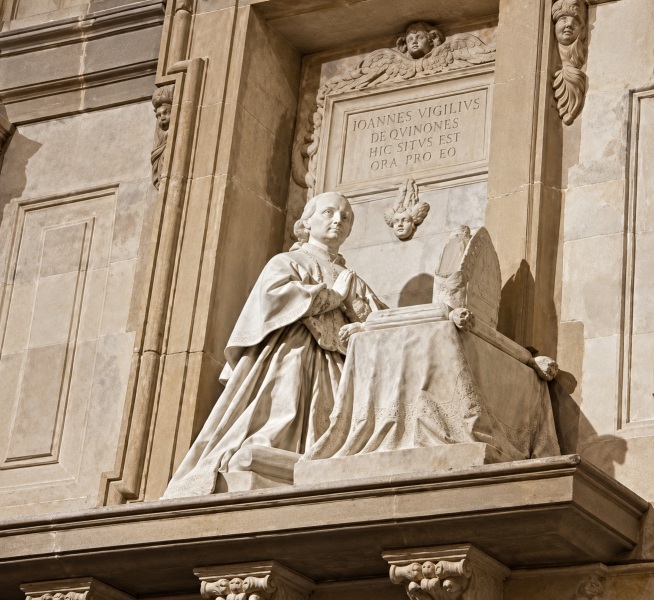
Juan Vigil de Quiñones at prayer, a work by Luis Fernández de la Vega, in the Vigiles Chapel of Oviedo Cathedral.
The sculpture was created after the bishop’s death and is notable for the naturalistic treatment of the face and the meticulous rendering of the vestments. Its arrangement, kneeling before a prayer desk and looking towards the altar, follows the tradition of the great kneeling funerary portraits of the 16th and 17th centuries.
The Altarpiece of the Annunciation
Opposite the funerary monument stands the altarpiece dedicated to the Annunciation. Its architectural design is by Alonso Carreño, while the reliefs were created by Luis Fernández de la Vega.
Carved in wood, the altarpiece is arranged in two tiers above a predella. The large central relief depicts the Annunciation, to which the chapel is dedicated, while the upper section shows the Baptism of Christ. The predella contains several scenes relating to the birth and childhood of Jesus, while the attic features God the Father giving his blessing.
The altarpiece was not originally polychromed. This absence of colour contributes to the ensemble’s distinctive visual unity and allows the modelling of the figures and the characteristic folds of the garments to be clearly appreciated.
Restoration of the Vigiles Chapel
The chapel’s original roof used stone slabs, a solution inspired by the Roman Pantheon that eventually caused serious problems with water infiltration and damp. As part of the Cathedral Master Plan, work was carried out on the roof in the late 1990s, after which it was necessary to wait several years for the walls to dry out.
Finally, between 2019 and 2020, the interior and the altarpiece were cleaned and restored, completing an intervention that recovered one of the most interesting artistic ensembles in Oviedo Cathedral.