

The Old Tower of Oviedo Cathedral
Beside the Holy Chamber stands one of the oldest and most distinctive elements of the Cathedral of San Salvador in Oviedo: the so-called Old Tower, or Romanesque tower. Its present appearance reveals two major building phases: a defensive lower section associated with the time of Alfonso III, and a Romanesque bell tower added at the end of the 11th century.
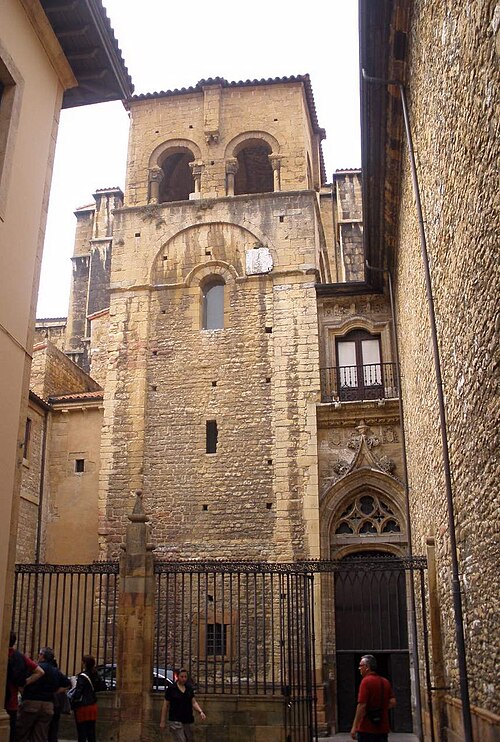
Old Tower of Oviedo Cathedral. Photograph: Zarateman / Wikimedia Commons. CC0 1.0.
One of the oldest structures in the Cathedral complex
The Old Tower predates by centuries the great Gothic structure that now dominates the appearance of Oviedo Cathedral. Its lower section is traditionally associated with defensive works carried out during the reign of Alfonso III (866–910), when Oviedo still retained particular importance as a political and religious centre of the Asturian kingdom.
Its proximity to the Holy Chamber is no coincidence. The tower is thought to have formed part of a defensive system protecting the area where relics and other particularly valuable objects associated with the see of Oviedo were kept.
Its original defensive character
The lower section has a very enclosed and robust architectural character, consistent with its defensive purpose. Its thick walls and few openings contrast sharply with the much more open upper section.
Oviedo Cathedral itself identifies this core as a defensive tower from the time of Alfonso III, possibly connected with the fortification of the city promoted by the monarch. Its position immediately beside the Holy Chamber would have strengthened the protection of one of the most religiously important places in the complex.
Transformation into a Romanesque bell tower
At the end of the 11th century, the structure was raised by adding a new section intended as a bell tower. This Romanesque extension significantly changed the appearance of the former defensive tower and accounts for much of its present-day form.
The bell tower opens to the exterior through paired openings on each of its façades. The arches rest on small columns topped by carved capitals, introducing architectural decoration that contrasts with the austerity of the lower section.
Why is it called the Old Tower?
The name distinguishes this old bell tower from the great Gothic tower erected on the Cathedral’s western façade from the 16th century onwards. For centuries, before that monumental tower was built, this Romanesque section served as the Cathedral’s bell tower.
Architecture of the bell tower
The Romanesque section of the bell tower is internally arranged on two levels. According to the Cathedral’s own description, the lower level is covered by a groin vault, while the upper level has a cloister vault.
From the outside, the contrast between the two building phases is particularly striking: the base retains the compact appearance of a defensive structure, while the Romanesque upper section is lightened by the openings of the bell tower.
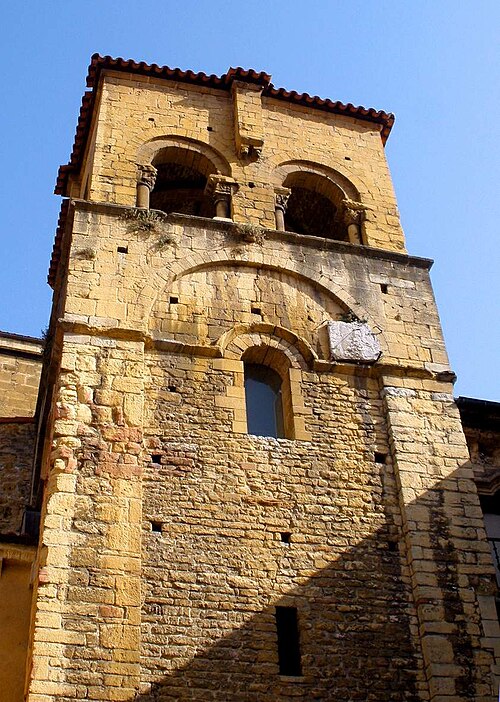
Detail of the Old Tower and its Romanesque bell tower. Photograph: Zarateman / Wikimedia Commons. CC0 1.0.
The Romanesque capitals
One of the most interesting details of the Old Tower can be seen in the small columns of the bell-tower openings. Their capitals feature decoration that Oviedo Cathedral stylistically relates to the capitals of the Royal Pantheon of San Isidoro in León.
This relationship helps place the tower’s extension within the artistic context of 11th-century Romanesque architecture and makes the bell tower one of the earliest surviving examples of this style in the Oviedo Cathedral complex.
The sundial of 1415
The Old Tower continued to play an active role in Cathedral life in later centuries. A particularly interesting reminder of this is the sundial placed on its south façade in 1415.
This feature reminds us that the tower should not be viewed solely as a structure from the 9th and 11th centuries: over time it was adapted to the Cathedral’s needs and accumulated evidence of different stages in its history.
The Old Tower and the Gothic tower
The best-known silhouette of Oviedo Cathedral is now dominated by the monumental tower of the main façade, built many centuries later. The Old Tower, however, reveals a much earlier stage in the history of the Cathedral.
While the great western tower belongs mainly to Gothic and Renaissance architecture, the Old Tower preserves within a single structure the memory of early medieval Oviedo and the Cathedral’s later Romanesque renewal.
This layering of different periods makes the Old Tower particularly valuable for understanding the architectural evolution of the San Salvador complex.