


Oviedo North Station
The railway gateway that transformed the city and gave purpose to the great urban axis of Calle Uría.
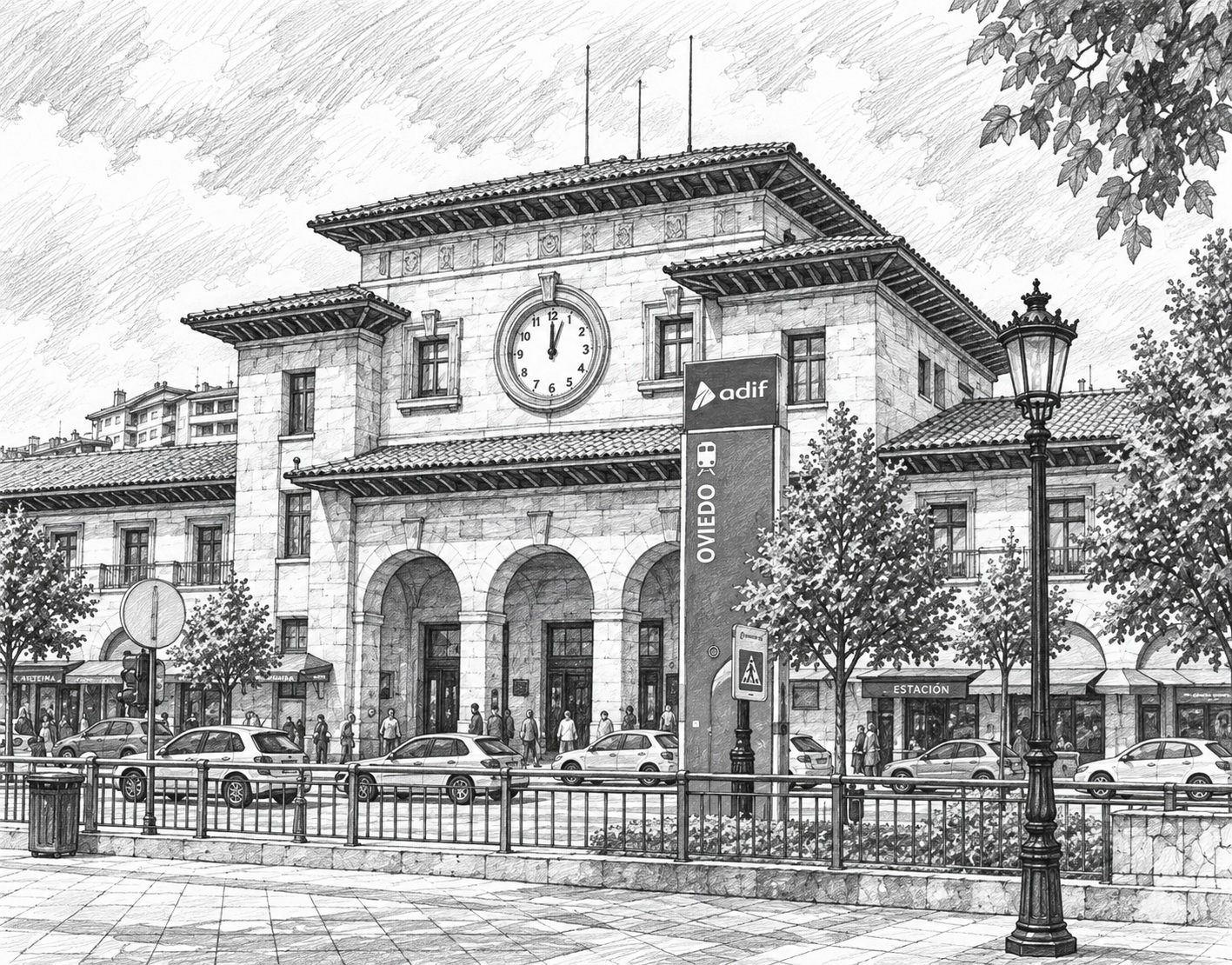
North Station · Oviedo
The arrival of the railway in Oviedo
Oviedo's first North Station opened in 1874. The arrival of the railway brought a decisive transformation to the city, improving communications and encouraging the economic and urban growth of the Asturian capital.
The station was located northwest of the historic centre. The need to connect it with the city centre helped establish Calle Uría as one of Oviedo's major urban thoroughfares, eventually turning it into the city's main shopping street.
The original 1874 station
The first passenger building belonged to the Compañía de los Caminos de Hierro del Norte de España, which is why the complex became popularly known as the North Station.
That 19th-century building remained in service for decades, but suffered significant damage during the Spanish Civil War. As a result, a major reconstruction was undertaken after the conflict.
The 1946 reconstruction
The building seen today is not essentially the same station that opened in 1874. It was rebuilt in 1946 following plans by architect Agustín Ballesteros.
The new building adopted a traditional and monumental architectural style. It is organised around a two-storey central pavilion flanked by two towers, with two long lateral wings extending from it.
At ground level, the large portico of semicircular arches stands out. The three larger central arches mark the main entrance to the station concourse.
La Losa and the integration of the railway
Another major transformation took place at the end of the 20th century. In 1998, substantial works began to improve the integration of the railway facilities into the city.
A large pedestrian deck supported by numerous pillars was built over much of the railway tracks. The project created a new urban space above the railway and provided a second access to the platforms from the rear of the station.
This new space, popularly known as La Losa, includes Plaza de los Ferroviarios, pedestrian areas, fountains and several sculptures.
A station for different railway networks
North Station was originally designed for the Iberian-gauge railway network. However, by the end of the 20th century it had also become the main hub for narrow-gauge railway services.
In 1999, following the closure of the Oviedo-Jovellanos and Oviedo-Económicos stations, services operated by the former FEVE network began using the main station. This strengthened its role as Oviedo's principal railway hub.
The station today
The station remains Oviedo's main railway terminal, bringing together long-distance, high-speed, medium-distance and commuter services, as well as lines from the former narrow-gauge network.
Asturias' connection to the high-speed rail network has increased the importance of the terminal. Adif has carried out improvements to the concourse and continues work aimed at preserving and modernising the historic building and its facilities.
Location and visit
Location: at the end of Calle Uría, one of Oviedo's main shopping and urban thoroughfares.
Access: the historic entrance is from the square at the end of Calle Uría, with a second entrance from La Losa.
Current use: working railway station. The passenger building, portico and large clock can be viewed during normal use of the terminal.