


Casa Camilo de Blas
Casa Camilo de Blas, on Calle Jovellanos in Oviedo, combines the architectural interest of a late-19th-century bourgeois building with the history of one of the city's most emblematic businesses: the Camilo de Blas confectionery, established here in 1914 and closely linked to the creation of the carbayón.
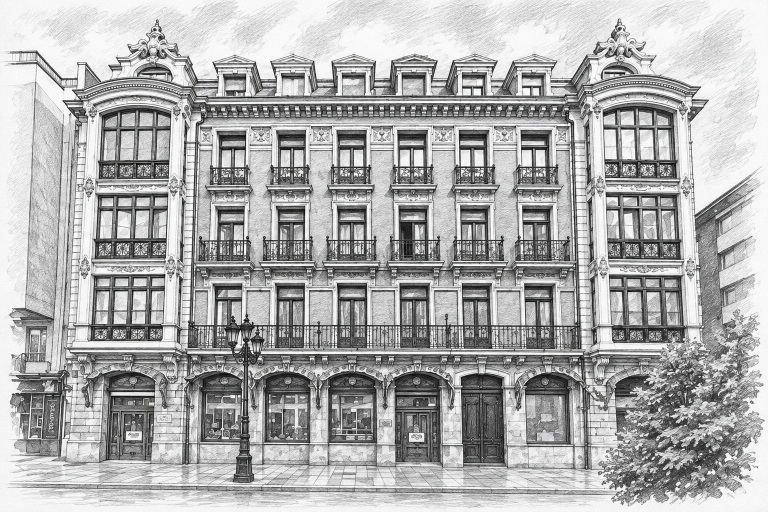
Casa Camilo de Blas · Calle Jovellanos · Oviedo
A historic house on Calle Jovellanos
Casa Camilo de Blas stands at number 7 Calle Jovellanos, very close to Oviedo's historic centre and Cathedral. The building is associated with the work of municipal architect Juan Miguel de la Guardia, a key figure in Oviedo's urban transformation between the late 19th and early 20th centuries.
Its architecture forms part of the group of bourgeois residential buildings that reshaped the appearance of the city during that period. The property is best known, however, for housing one of Oviedo's most emblematic historic businesses on its ground floor: the Camilo de Blas confectionery.
Juan Miguel de la Guardia
Casa Camilo de Blas is among the works attributed to Juan Miguel de la Guardia, Oviedo's municipal architect from 1882 to 1910. His work left a lasting mark on the city and is connected with other buildings on this route, including Casa del Deán Payarinos and Casa Conde.
The building reflects the eclectic architectural climate of the late 19th century, when residential architecture adopted more monumental façade compositions and decorative features intended to express the city's emerging bourgeois character.
Camilo de Blas arrives in Oviedo
The history of the confectionery began in León, where Camilo de Blas Heras opened a shop in 1876. Decades later, the family expanded the business into Asturias.
In February 1914, Camilo de Blas opened a confectionery in Oviedo for his son José, establishing it on Calle Jovellanos. The business remains at the same location and has passed through successive generations of the family.
The interior preserves historic features of the shop, including its Carrara marble counter and distinctive columns.
The birth of the carbayón
In 1924, the pastry that would become one of Oviedo's gastronomic symbols was created here. José de Blas and master confectioner José Gutiérrez made a pastry with puff pastry, almonds, egg yolk and sugar to represent the city at the Gijón Trade Fair.
The new sweet was named carbayón, a popular name for the people of Oviedo associated with the former Carbayón oak tree on Calle Uría. Over time, the pastry became one of the most characteristic specialities of Asturian confectionery.
The fire and preservation of the shop
In the late 1920s, the confectionery suffered a serious fire. Afterwards, the shop was restored while preserving the façade and numerous features of the original premises.
The continuity of the family business and the preservation of its historic appearance mean that the premises on Calle Jovellanos are now much more than a confectionery: they are an important part of Oviedo's commercial heritage.
A confectionery on the big screen
The historic character of the shop has also attracted film and television productions. The confectionery appeared in ¡Jo, papá!, directed by Jaime de Armiñán, and decades later was used as a location for Woody Allen's Vicky Cristina Barcelona.
These appearances helped introduce the distinctive image of the Calle Jovellanos establishment to audiences beyond Asturias.
Location and visit
Address: Calle Jovellanos, 7 · 33003 Oviedo.
Location: in the historic centre, just a few minutes' walk from Oviedo Cathedral and Calle Gascona.
Coordinates: 43.36317, -5.84463.
Visit: the ground floor is still occupied by the Camilo de Blas confectionery. It is therefore one of the buildings on this route where visitors can also experience the historic commercial establishment that gives the building its name.