


National Social Security Institute
The former National Social Security Institute building in Oviedo, located in Plaza del Carbayón, is one of the key works of Asturian Rationalism. It was designed in 1934 by Joaquín Vaquero Palacios and completed in 1942.
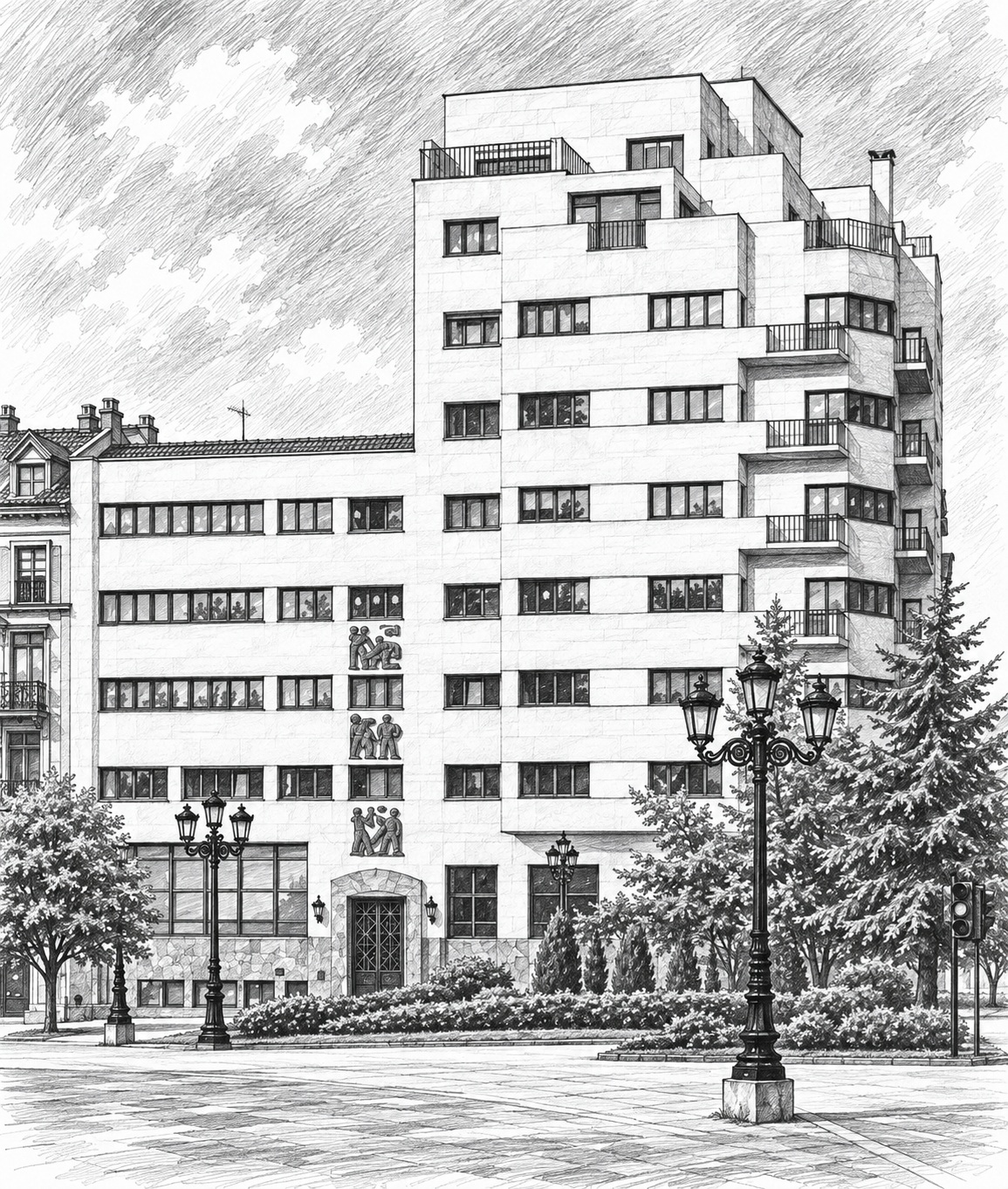
Former National Social Security Institute · Plaza del Carbayón · Oviedo
A landmark of Asturian Rationalism
The former National Social Security Institute stands in Plaza del Carbayón, at the corner with Calle Argüelles. It was designed in 1934 by Joaquín Vaquero Palacios and completed in 1942, following interruptions caused by the October 1934 uprising and the Spanish Civil War.
Despite the long construction process and the political changes of those years, the building retained the Rationalist conception of the original design. It is regarded as one of the most notable examples of the Modern Movement in Asturias.
Joaquín Vaquero Palacios
Joaquín Vaquero Palacios was born in Oviedo in 1900 and worked as an architect, painter and sculptor. After graduating in Madrid in 1927, he travelled through Europe and the Americas, where he encountered the international avant-garde and modern architecture first-hand.
In the early 1930s he developed remarkably modern architecture in Asturias. The National Social Security Institute is one of the outstanding works of this first Rationalist period.
Decades later, Vaquero Palacios would leave further important works in Asturias, including the Grandas de Salime power station, the Hidroeléctrica del Cantábrico headquarters in Oviedo and the Proaza hydroelectric power station.
Offices and housing in two volumes
The programme had to accommodate two different functions: offices for the National Social Security Institute and housing for its employees. Vaquero Palacios made this separation visible through two complementary volumes.
The office wing consists of a ground floor and three upper storeys. The residential block rises higher, with a ground floor and eight upper storeys, and stands at the street junction, becoming the main vertical element of the complex.
Originally, the residential block contained sixteen flats, two per floor, as well as a roof garden for residents.
Geometry and absence of ornament
The architecture follows Rationalist principles: clean volumes, flat roofs, large openings, functional use of space and an almost complete absence of exterior ornament.
The composition relies on the contrast between horizontal and vertical lines and on the arrangement of windows, terraces and projecting volumes. The result is an architecture in which the exterior form directly expresses the internal organisation.
This austerity marked a break with much of the monumental and decorative architecture that had dominated Oviedo during the first decades of the 20th century.
The Mural of Labour
Vaquero Palacios no separaba completamente arquitectura y artes plásticas. Para el nuevo edificio realizó también una gran pintura mural destinada a su interior, conocida como Mural of Labour y relacionada igualmente con el carbón y la pesca.
Measuring approximately five by four metres, the work belongs to the so-called “black period” of his painting, in which he depicted the industrial, mining and maritime landscapes of Asturias in dark tones.
The mural is an early example of a concern that would accompany Vaquero throughout his career: integrating painting, sculpture and architecture within a single work.
From the National Social Security Institute to SESPA
The building eventually ceased to serve its original purpose as the headquarters of the National Social Security Institute and later became known as the INSALUD building. Today it houses offices of the Asturian Health Service (SESPA).
The former flats at 8 Calle Argüelles were also converted into offices. The building has undergone several refurbishment projects to adapt it to its new functions.
In October 2024 it received a plaque from the DOCOMOMO Ibérico Foundation recognising its inclusion in the register of representative buildings of the Modern Movement.
Location and visit
Address: Plaza del Carbayón, 1 / Calle Argüelles, 8 · 33001 Oviedo.
Coordinates: 43.363119, -5.846583.
Current use: offices of the Asturian Health Service (SESPA).
Visit: the building is not operated as a tourist monument with regular visits. Its exterior architecture can be viewed freely from Plaza del Carbayón and Calle Argüelles.