


Gargoyles of Oviedo Cathedral
High on the Cathedral of San Salvador in Oviedo, among buttresses, pinnacles, cornices and roofs, there is a remarkable collection of stone gargoyles. Animals, fantastic creatures and human or grotesque figures form one of those details of the building that often go unnoticed when the Cathedral is viewed from street level.
Although today they attract particular attention for their sculptural appearance, gargoyles were created above all for a practical purpose: to drain rainwater and carry it away from the walls. In Gothic architecture, this technical function also became an opportunity to populate the upper parts of buildings with an extraordinary world of imagery.
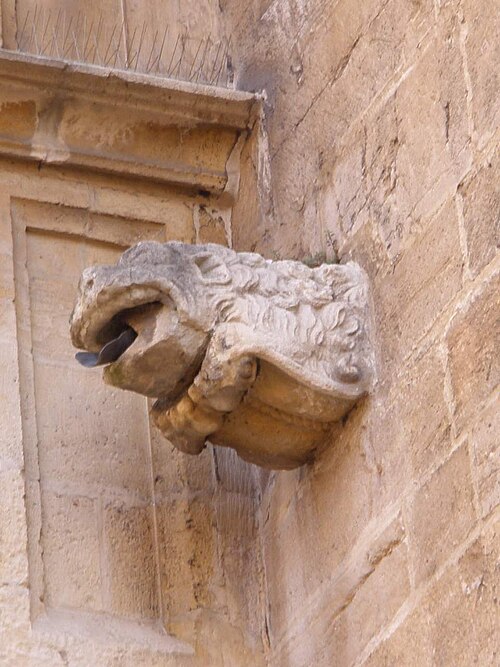
Gargoyle of Oviedo Cathedral. Photo: Zarateman / Wikimedia Commons (CC0).
Gargoyles: sculptures that also serve as waterspouts
The essential function of a gargoyle is to channel rainwater collected on the roofs away from the building. Its channel projects the water some distance from the façade, helping to prevent it from running directly down the walls and damaging the stone.
At Oviedo Cathedral, this relationship between architecture and water drainage can clearly be seen: the upper-level channels and drainage elements direct the water towards the gargoyles. A practical building requirement is thus transformed into an ornamental feature characteristic of medieval architecture.
Animals and fantastic creatures
The gargoyles of San Salvador display a remarkable variety of forms. They include real animals and fantastic or mythological creatures, following a tradition widespread among the great Gothic buildings of Europe.
Among the figures identified at Oviedo Cathedral are griffins, eagles and ape-like figures. Some images combine features of different animals, while others exaggerate expressions, mouths or postures to create a deliberately strange appearance.
The griffin, a fantastic creature traditionally combining the features of an eagle and a lion, appears on several gargoyles on the tower. The collection demonstrates the imaginative freedom with which sculptors could approach these functional elements.
Human figures and grotesque faces
Not all the gargoyles depict animals. The Cathedral’s collection also includes anthropomorphic figures, faces and grotesque characters. Their exaggerated gestures and unusual postures form part of the distinctive visual language of these sculptures.
One of the most striking figures described at the Cathedral is a faun, associated with the fantastic and moralising traditions of the Middle Ages. There are also human figures in contorted poses and other images whose interpretation is not always clear.
Care should be taken when assigning a specific meaning to each figure. Some may have had a symbolic or moral purpose, while others reflect the medieval taste for the fantastic, the monstrous and the humorous.
The cloister gargoyles
The collection is not limited to the tower and façades. The Gothic cloister also preserves its own gargoyles, which differ in appearance from many of those located high on the Cathedral.
Small human and animal heads predominate in the cloister, including forms described as dogs and cats, as well as schematic or mask-like faces. Their smaller size and location reveal another facet of this sculptural decoration.
Visitors interested in these details can complement their tour by consulting the page devoted to the Cloister and Chapter House of Oviedo Cathedral.
Look up: where to find the gargoyles
To discover the gargoyles of San Salvador, look away from the doorways for a few moments and turn your gaze towards the upper parts of the building. The Gothic tower has a significant number of them, although examples can also be found on other exterior areas and in the cloister.
Some figures can be seen with the naked eye from the square and the streets around the Cathedral, but a small pair of binoculars or a camera zoom makes it much easier to appreciate their forms and expressions.
A visit to the Gothic Tower of Oviedo Cathedral also provides a privileged view of the upper parts of the building and allows visitors to see architectural details that are difficult to appreciate from street level.