


Casas del Cuitu
The Casas del Cuitu are one of Oviedo’s most distinctive residential complexes. Built between 1913 and 1917 on Calle Uría, they combine Art Nouveau features with exuberant Neo-Baroque influences.
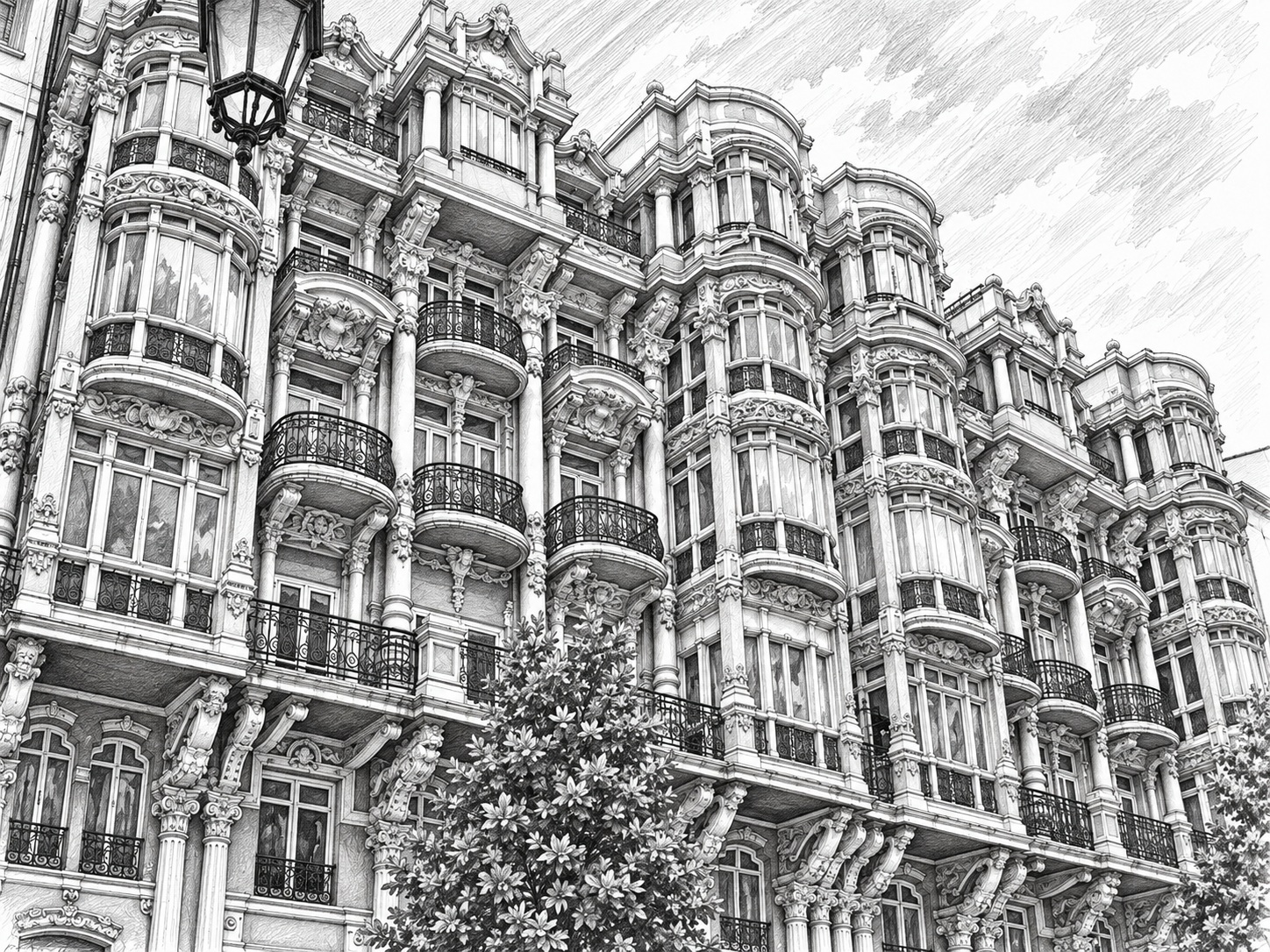
Casas del Cuitu · Calle Uría · Oviedo
A major property development on Calle Uría
The Casas del Cuitu are one of Oviedo’s most distinctive residential complexes. They were built between 1913 and 1917 at the initiative of José Álvarez Santullano, an emigrant who had made his fortune in the Americas and was known as “El Cuitu”, on a site between Calle Uría and Calle Independencia.
Los planos fueron firmados por el maestro de obras Ulpiano Muñoz Zapata. The complex está formado por cuatro casas y ocupa una superficie construida superior a los 8.000 metros cuadrados.
Their construction marked a change of scale on Calle Uría. In an area where villas and lower-rise houses were still common, the Cuitu anticipated the large apartment buildings that would become dominant in the following decades.
Ulpiano Muñoz Zapata
Ulpiano Muñoz Zapata was one of Asturias’ most active master builders from the late 19th to the early 20th century. A major part of his career was spent in Oviedo, where he signed hundreds of projects between 1887 and 1921.
His architecture is characterised by highly decorative eclecticism and frequent approaches to Art Nouveau. The Casas del Cuitu are among the most important works of his career and one of the most recognisable examples of this cosmopolitan tendency.
Art Nouveau with Neo-Baroque influences
The building combines Art Nouveau features with strong Neo-Baroque influences. Its façade is richly ornamented, in marked contrast with the greater restraint of other buildings on Calle Uría.
Bay windows, balconies, corbels, jambs and sculptural elements create a façade of great visual richness. Some of the corbels take human or mythological forms and appear to support the projecting sections of the building.
The combination of volumes, openings and decoration creates a pronounced vertical effect that further emphasises the considerable height of the complex.
Four buildings and two façades
Although from Calle Uría it may appear to be a single large building, the complex actually consists of four buildings. Their main façades extend across numbers 27 and 29 Calle Uría and Calle Independencia.
Esta disposición permite comprender la verdadera dimensión de la operación inmobiliaria promovida por José Álvarez Santullano. The complex no se limita a una fachada monumental: ocupa una gran parcela que conecta dos importantes vías del ensanche ovetense.
Where does the name “Cuitu” come from?
The building takes its name from the nickname of its developer, José Álvarez Santullano, known as “El Cuitu”. Having made his fortune in the Americas, he undertook this ambitious property development in Oviedo.
After financial difficulties, ownership passed to Banco Herrero, which retained the property for several decades. The popular name, however, survived every change of ownership and ultimately became the permanent name of the complex.
Protection y futuro del edificio
The Casas del Cuitu are included in Oviedo’s urban heritage catalogue and enjoy comprehensive special protection. Their significance lies both in their architecture and in their importance for understanding the transformation of Calle Uría in the early 20th century.
In 2002 the complex was acquired by a property company belonging to the Masaveu Group. The company itself highlights the Casas del Cuitu as one of its most distinctive properties, with 8,383 square metres of built area.
The building has been awaiting comprehensive restoration for years, although this does not prevent visitors from appreciating from the street one of the most spectacular façades of early-20th-century Oviedo.
Location and visit
Address: Calle Uría, 27–29 · Oviedo.
Façades: Calle Uría and Calle Independencia.
Coordinates: 43.36522, -5.85354.
Visit: there are no regular tourist visits to the interior. The main façade can be freely viewed from Calle Uría, and it is worth walking around the complex to see how it extends towards Calle Independencia.