


Oviedo City Hall
Oviedo City Hall, or the Casa Consistorial, stands prominently on Plaza de la Constitución and is one of the most representative buildings in the city's historic centre. Its origins date back to the 17th century, and one of its most distinctive features is that it was built over the former medieval Cimadevilla Gate.
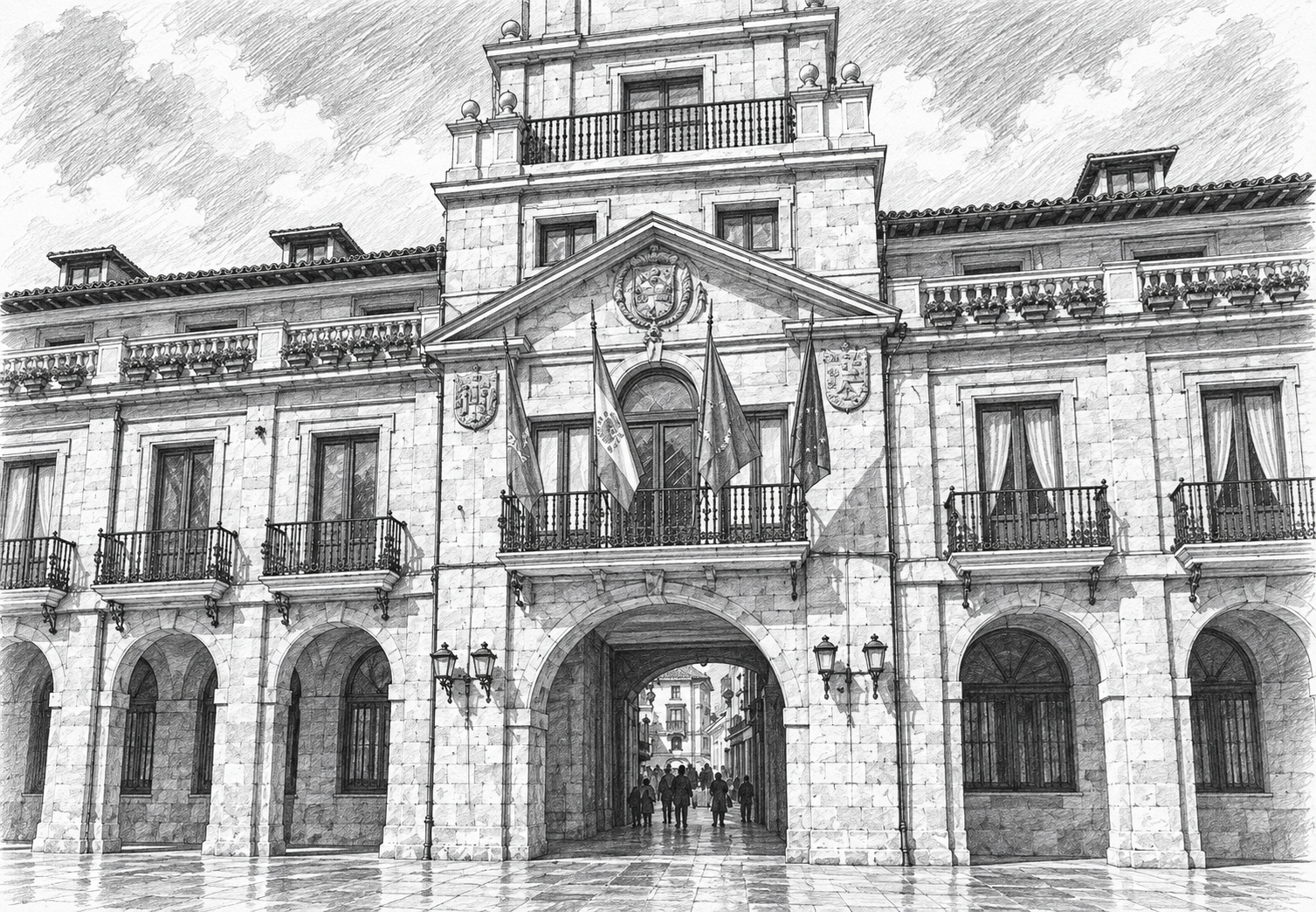
Oviedo City Hall · Plaza de la Constitución
The seat of the city government
The City Hall presides over Plaza de la Constitución and is one of the most recognisable buildings in Oviedo's historic centre. Before the city had its own permanent municipal headquarters, council meetings were held at various locations around Oviedo, including the area around the Church of San Tirso.
In 1622, architect Juan de Naveda was commissioned to design the new municipal buildings. He incorporated part of the medieval city wall into the project and, most importantly, integrated the old Cimadevilla Gate, one of the main entrances to the medieval walled city.
The Cimadevilla Arch
The most distinctive feature of Oviedo City Hall is the large arch that passes through its central section. It is more than simply an architectural feature: it marks the site of the former Cimadevilla Gate, through which the medieval city was entered from the south.
The central section of the City Hall was built above this passage. Arcaded wings were developed on either side and extended in different stages, meaning that the building seen today is the result of several centuries of construction and transformation.
Extensions during the 17th and 18th centuries
The first phase designed by Juan de Naveda was completed in 1623. Several decades later, the complex was extended eastwards, following the architectural language of the original building. Marcos de Velasco took part in this phase.
In 1778, the City Council commissioned Francisco Pruneda to carry out a further extension because the municipal premises had become too small. The project extended the building towards Calle del Sol and added new rooms and a main staircase.
Destruction during the Spanish Civil War
The City Hall suffered severe damage during the siege of Oviedo in the Spanish Civil War. The damage was so extensive that the municipal authorities had to move temporarily to the Palace of the Duke of Parque .
After the war, the building was reconstructed between 1939 and 1940. The work particularly altered its central section and created the present clock tower, designed by Gabriel de la Torriente. Therefore, although the City Hall retains its historic origins and organisation, an important part of its present appearance dates from this 20th-century reconstruction.
Plaza de la Constitución
The City Hall occupies the northern side of Plaza de la Constitución, Oviedo's former main square. In front of its façade lies one of the most important historic urban spaces in the city.
On one side of the square stands the Church of San Isidoro el Real . Several streets lead away from the square, including Cimadevilla, Jesús, Fierro, Magdalena and Sol, making it an important link between the old town, the Fontán area and the main pedestrian streets of central Oviedo.
Location and visit
Address: Plaza de la Constitución · 33009 Oviedo.
Location: in the heart of Oviedo's historic centre, overlooking Plaza de la Constitución and next to the Church of San Isidoro el Real.
Current use: headquarters of Oviedo City Council. The arcades and Cimadevilla Arch form part of the usual pedestrian route through the historic centre. Access to the interior offices is subject to the building's administrative use.