


San Isidoro el Real
The church of San Isidoro el Real, located in Oviedo’s Plaza de la Constitución, was originally built as the church of the Jesuit College of San Matías. Its architecture combines Classical and Baroque elements, making it one of the most notable religious buildings in Oviedo’s historic centre.
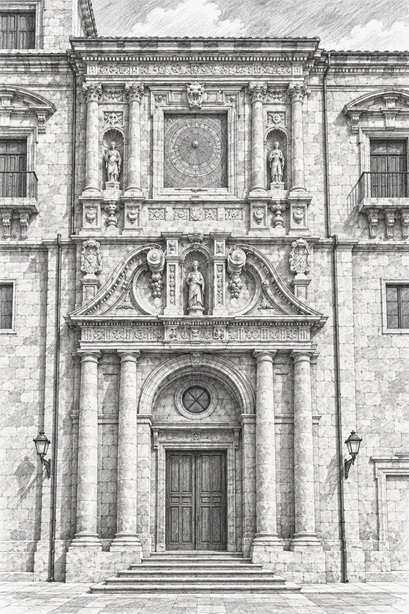
San Isidoro el Real · Plaza de la Constitución, Oviedo
From San Matías to San Isidoro el Real
The church now known as San Isidoro el Real was originally built for the College of San Matías of the Society of Jesus. Construction began in 1578 under the patronage of Magdalena de Ulloa and continued until 1681, although the interior decoration was developed further over the following decades.
After the expulsion of the Jesuits in 1767, the building took on a new role. On 17 April 1770, the historic parish of San Isidoro, previously located near today’s Plaza del Paraguas, was transferred here. From then on, the former Jesuit church became the parish church of San Isidoro el Real.
A façade between Classicism and Baroque
The façade reflects the different stages in the church’s construction. The lower section follows a Classical composition, while the upper section displays a distinctly Baroque character associated with the work of the architect Francisco Menéndez Camina, from Avilés.
At the centre is the main entrance, larger than the side doorways, with an image of Saint Isidore above it. The upper section incorporates columns, niches and balconies, creating a monumental composition overlooking one side of Plaza de la Constitución.
The interior and its Baroque altarpieces
The interior is arranged around a main nave with lateral spaces converted into chapels connected by semicircular arches. In contrast with the relative restraint of the exterior, the church preserves significant Baroque decoration inside.
Among its most notable works are the high altarpiece, the so-called Passion Altarpiece and the Calvary Altarpiece. They include works associated with sculptors such as Luis Fernández de la Vega and Antonio de Borja. The church also houses the tomb of Martín Carrillo Alderete, a former Bishop of Oviedo who later became Archbishop of Granada.
The former College of San Matías
San Isidoro is the main surviving element of the former Jesuit complex of San Matías. The college and its associated buildings once occupied a large area beside the church, but disappeared during the 19th-century redevelopment of this part of the Fontán district.
The church therefore remains both an architectural reminder of the Jesuit presence in Oviedo and the continuation of one of the city’s historic parishes, whose origins date back to around the year 1200.
Location and visit
Address: Plaza de la Constitución · 33009 Oviedo.
Location: in the heart of Oviedo’s historic centre, opposite the City Hall and next to the Fontán district.
Visiting: the church remains an active place of worship. Visiting hours may change, so it is advisable to check current parish information and avoid tourist visits during religious services.