


Toreno Palace in Oviedo
Toreno Palace, also known as Malleza-Toreno Palace, is one of the finest examples of Baroque palace architecture in Oviedo’s historic centre. It was built between 1673 and 1675 by the architect Gregorio de la Roza and today houses the Royal Institute of Asturian Studies (RIDEA).
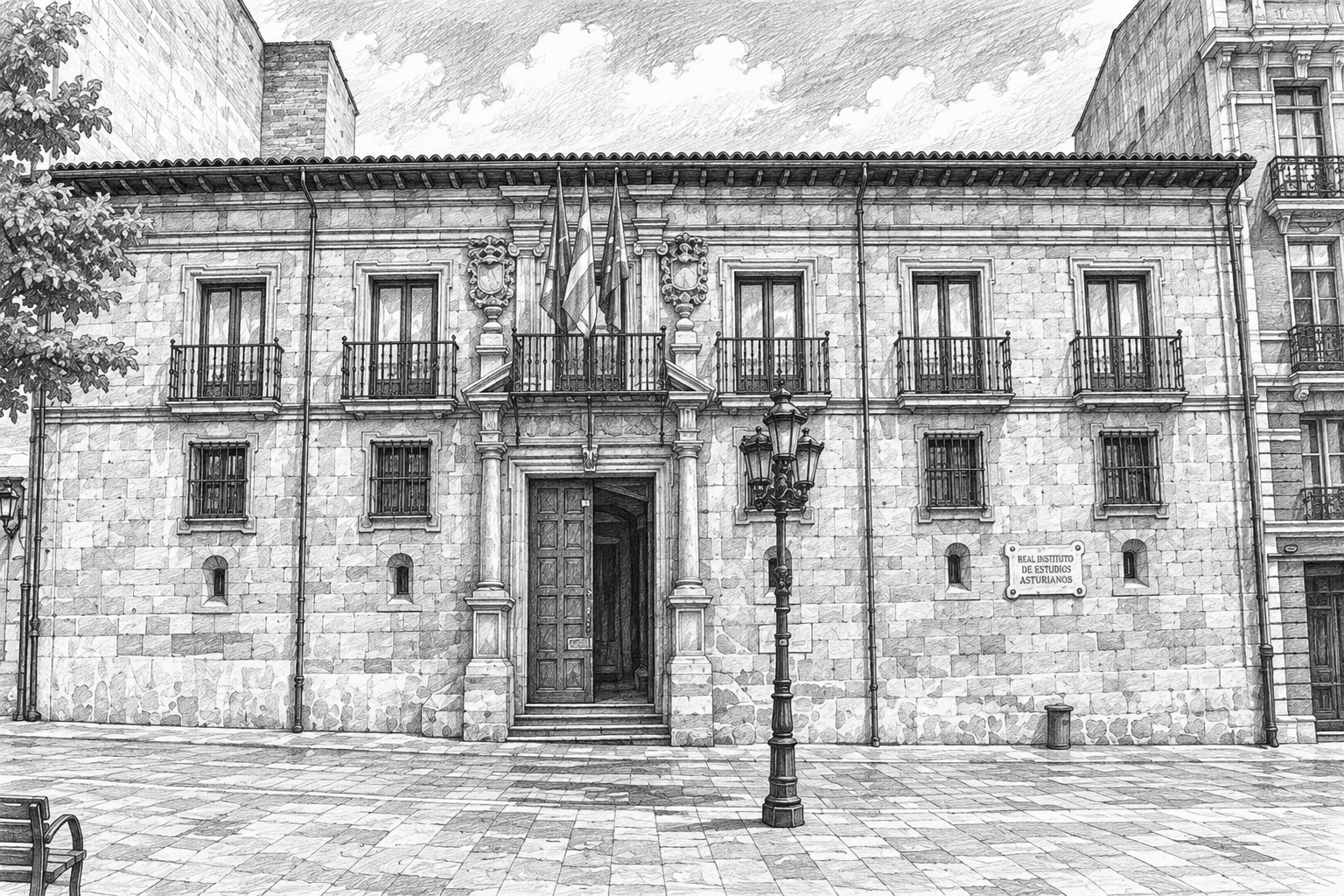
Toreno Palace · Oviedo
The former Malleza Palace
The present Toreno Palace was built between 1673 and 1675 by master builder and architect Gregorio de la Roza for the Malleza-Dóriga family. Because of these origins, it is also known as Malleza-Toreno Palace.
At the end of the 17th century, through marriage, the property became part of the estate of the Counts of Toreno, linking its history to one of Asturias’ best-known noble families.
A fully urban Baroque palace
The building was erected between adjoining properties within the old city walls. Its layout extends deep into the plot, with rooms arranged around a quadrangular arcaded inner courtyard.
Gregorio de la Roza dispensed with the traditional defensive towers and designed a residence more closely integrated into the urban fabric. At the rear he also created a private south-facing garden, an innovative feature in Oviedo’s noble residences of the period.
The courtyard and monumental staircase
Inside, the arcaded courtyard is particularly noteworthy, supported by large Tuscan-order columns. A monumental stone staircase rises from the courtyard and connects the different floors of the palace.
The combination of the entrance portal, courtyard, columns and absence of towers illustrates the transition from defensive aristocratic residences to a new model of urban Baroque palace.
From noble residence to the Royal Institute of Asturian Studies
Toreno Palace was declared a national Historic-Artistic Monument in 1983. During much of the 20th century it served cultural and administrative purposes, housing the Provincial Public Library and the Provincial Historical Archive until 1987.
Since 1957 it has been the headquarters of the Royal Institute of Asturian Studies (RIDEA), an institution devoted to the study, research and dissemination of the culture, history and heritage of Asturias.
The Count of Toreno
José María Queipo de Llano y Ruiz de Saravia, 7th Count of Toreno, was born in this palace in 1786. A prominent politician and historian in the early 19th century, he took part in political life during the Peninsular War and became President of the Council of Ministers in 1835.
Location and visit
Address: Plaza de Porlier, 9 · 33003 Oviedo.
Location: in the heart of Oviedo’s historic centre, very close to Camposagrado Palace and the Cathedral.
Current use: headquarters of the Royal Institute of Asturian Studies (RIDEA). The exterior can be viewed freely from the square; access to the interior depends on the institution’s activities and opening arrangements.