


Oviedo’s sacaveras: little dragons in the heart of the city
Among Oviedo’s most unusual inhabitants is one that almost always goes unnoticed: the sacavera, the traditional Asturian name for the salamander, a small black amphibian with striking yellow markings that still lives in gardens, walls and damp corners of the city.
Oviedo’s salamanders have traditionally been identified with the subspecies Salamandra salamandra bernardezi. Although the name may seem repetitive, it is correct: Salamandra is the genus, salamandra the species and bernardezi the subspecies. Their urban populations are particularly interesting because they have managed to survive for generations in areas completely surrounded by streets and buildings.
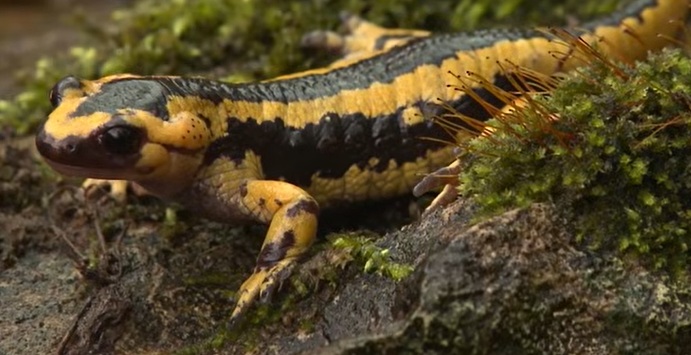
Sacavera, the traditional Asturian name for the salamander.
They are discreet and mainly nocturnal animals. During the day they remain hidden among stones, cracks, roots and other damp shelters. They are easier to spot on mild, rainy nights, when they emerge from their hiding places to feed and move around.
Why are they so special?
One of the keys to their survival in an urban environment lies in the way they reproduce. These salamanders can give birth to already metamorphosed young, capable of living on land without needing a permanent pond in which to complete an aquatic larval stage.
This adaptation is especially useful in a historic city centre, where gardens, stone walls and damp refuges exist but the permanent bodies of water required by other amphibians for reproduction are scarce.
Their black-and-yellow colouring is another of their most recognisable features. As with other salamanders, glands in their skin produce defensive substances, so they should not be handled. If you find one, the best thing to do is observe it without touching it and let it continue on its way.
Where Oviedo’s sacaveras live
Sacaveras are particularly well known in Oviedo’s historic centre. Populations are associated with the area around the Cathedral, the former pilgrims’ cemetery and San Pelayo Monastery, as well as other gardens and green spaces in the city.
Salamanders have also been found in other urban areas, including Campo de San Francisco. Small gardens isolated by streets and buildings act as genuine green islands where these amphibians have been able to survive.
Finding them is not always easy. Their nocturnal habits and tendency to remain hidden during colder or drier periods mean that thousands of people pass close to their refuges every day without realising they are there.
A salamander linked to the history of Oviedo
The relationship between sacaveras and the city is not recent. The presence of salamanders around the Cathedral was even reflected in art: representations of these animals can be found in historic elements of Oviedo Cathedral, including the choir stalls and a capital in the cloister.
Over time, the sacavera has also become a small popular symbol of Oviedo. Its yellow and black colours have inspired kits linked to the city’s football history, and its image appears in cultural and educational initiatives devoted to this unusual urban inhabitant.
Their survival in the heart of the city is a reminder that Oviedo is not only about its monumental heritage. Among its historic buildings there is also a discreet and surprising natural heritage that has coexisted for centuries with generations of Oviedo residents.
Related: you can also discover Oviedo Cathedral and the Cathedral cloister and chapter house.