


San Vicente Monastery
The former San Vicente Monastery is one of the historic sites most closely linked to the origins of Oviedo. The Benedictine monastery, transformed over the centuries, now houses a major part of the Archaeological Museum of Asturias.
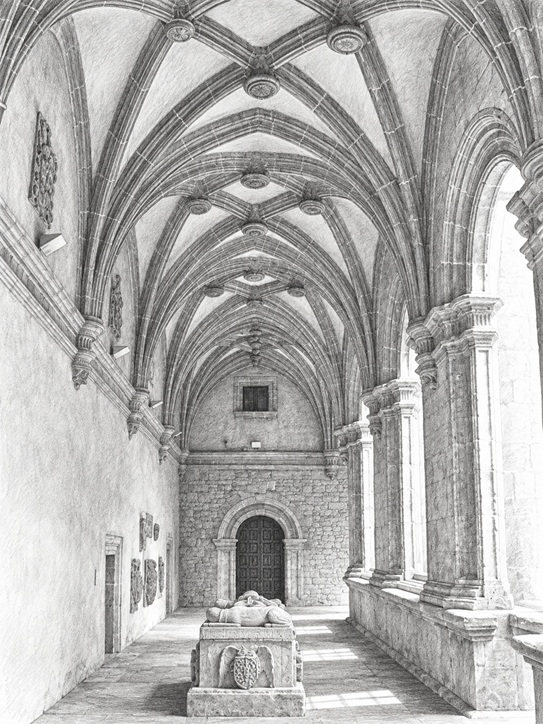
Cloister of San Vicente Monastery
A monastery linked to the birth of Oviedo
Documentary tradition places the origins of San Vicente Monastery in the year 761, when the priest Máximo and Abbot Fromestano are said to have settled in a place called Oveto and founded a monastery dedicated to Saint Vincent the Martyr. This account has been the subject of historiographical debate and should therefore be understood as the traditional foundation story associated with the origins of the city.
As Oviedo developed as the centre of the Asturian monarchy, San Vicente became closely connected with the religious complex of San Salvador. The first documentary reference to the monastery as an established community dates from the 10th century.
The Benedictine monastery
San Vicente became one of Oviedo’s principal monastic institutions. None of the original Early Medieval buildings survives, as the complex was altered and enlarged over the centuries.
The architecture visible today largely dates from the major renovation undertaken in the Early Modern period. Its most notable feature is the 16th-century Gothic-Renaissance cloister, arranged around a courtyard and now incorporated into the visitor route of the Archaeological Museum of Asturias.
Feijoo and San Vicente
Among the figures most closely associated with the monastery is Benito Jerónimo Feijoo (1676–1764), a Benedictine monk, essayist and one of the leading figures of the Spanish Enlightenment. Feijoo lived at San Vicente and carried out much of his intellectual work in Oviedo.
His presence reinforces the monastery’s importance not only as an architectural complex but also as one of the key places in the cultural history of the city.
From monastery to Archaeological Museum
The monastic community was dissolved in 1835 as a result of the Spanish confiscation of church property. Since then, the different parts of the complex have had both civil and religious uses. Today, a major part of the former monastery houses the Archaeological Museum of Asturias.
The museum allows visitors to walk through the historic cloister while exploring the history of Asturias from Prehistory through the Middle Ages and into the beginning of the Early Modern period. The church of San Vicente, meanwhile, remains in religious use as part of the parish of Santa María la Real de la Corte.
Location and visit
Address: Calle San Vicente, 5 · 33003 Oviedo.
Location: in Oviedo’s historic centre, next to San Pelayo Monastery and very close to Oviedo Cathedral.
Visit: the former cloister forms part of the Archaeological Museum of Asturias. Opening hours and access conditions may vary, so it is advisable to check the museum’s latest information before visiting.